Most crypto content is built to tell you what happens next. A price target, a call, a signal. It sounds confident, it travels fast — and it quietly hands you all of the risk while keeping none of the responsibility.
Pineva is built on a different premise. You don’t need to be told what the market will do. You need a clearer way to decide what you will do. This page is the map of how we think — the ideas behind every scenario, every risk plan and every screen in the workspace. Understand this page, and you understand Pineva.
Research before risk
Everything we do runs in one order: understand first, define risk second, decide last. Most avoidable losses come from reversing it — acting first, then trying to understand the position you’re already in, usually while it’s moving against you.
So before a scenario or a stop-loss ever enters the picture, the first question is simply: what is actually going on here? That means spot research — fundamentals, context and your watchlist in one place — so you build a fuller picture before you take any position. Research isn’t the boring part before the trade. It’s the part that makes the trade a decision instead of a guess.
Scenarios, not predictions
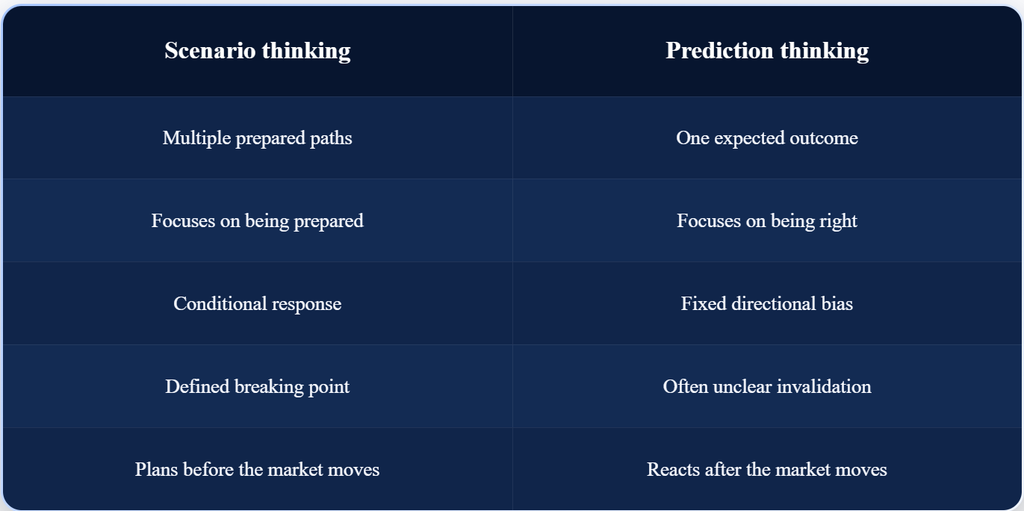
A prediction is a single guess about the future: one price, one direction, one outcome. It feels decisive, but it hides your risk, ties your ego to being right, and never tells you when to walk away.
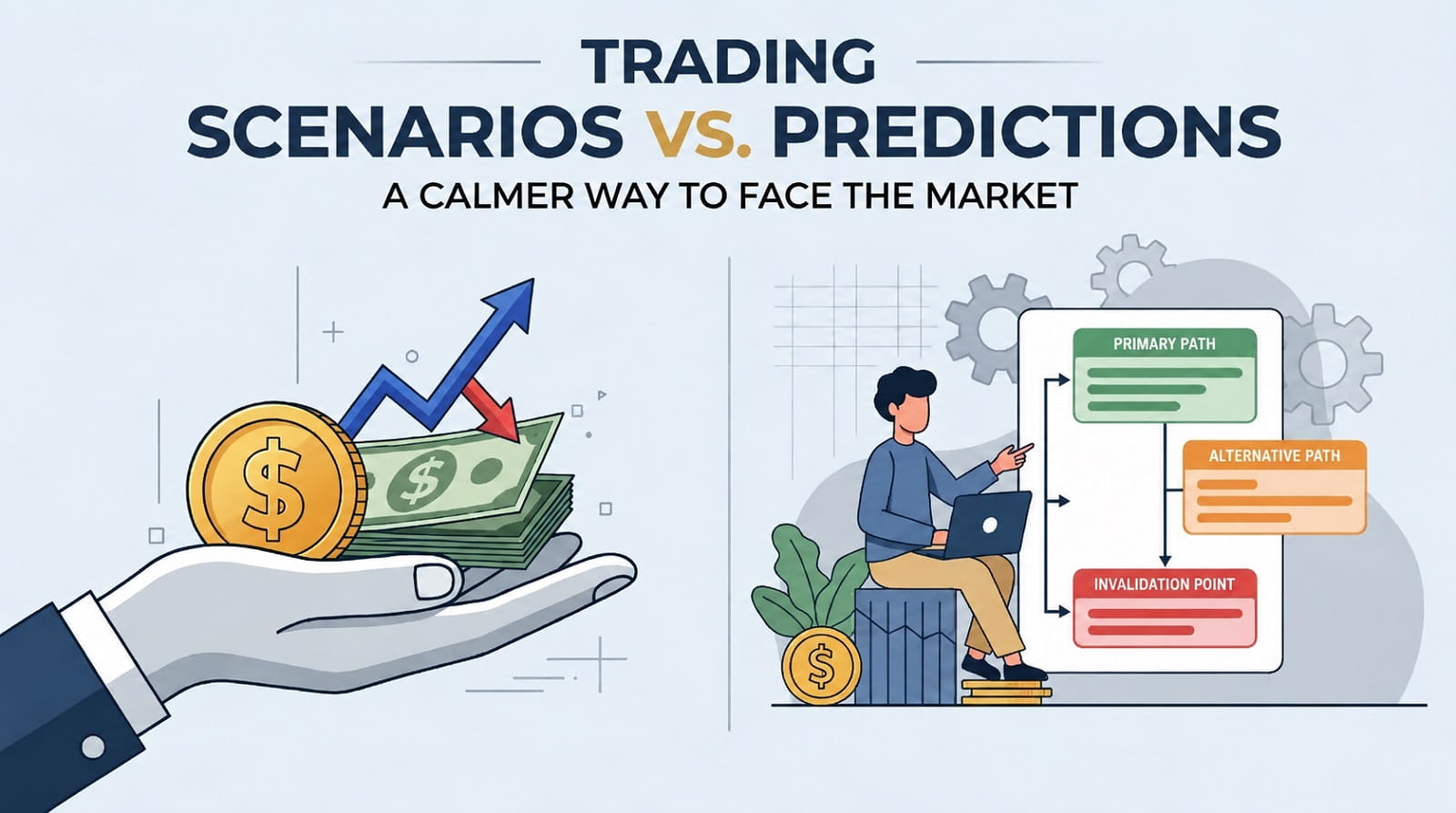
A scenario is different. It’s a small set of conditional paths, each with a trigger (the condition that puts it in motion) and a breaking point (the level at which it’s simply wrong). Instead of betting on one future, you prepare for several — and you already know what you’ll do in each. We make the full case for this in the full argument in Trading Scenarios vs. Predictions, but the short version is this: you don’t have to be right about the future to trade well. You have to be prepared for it.
Every idea needs an invalidation
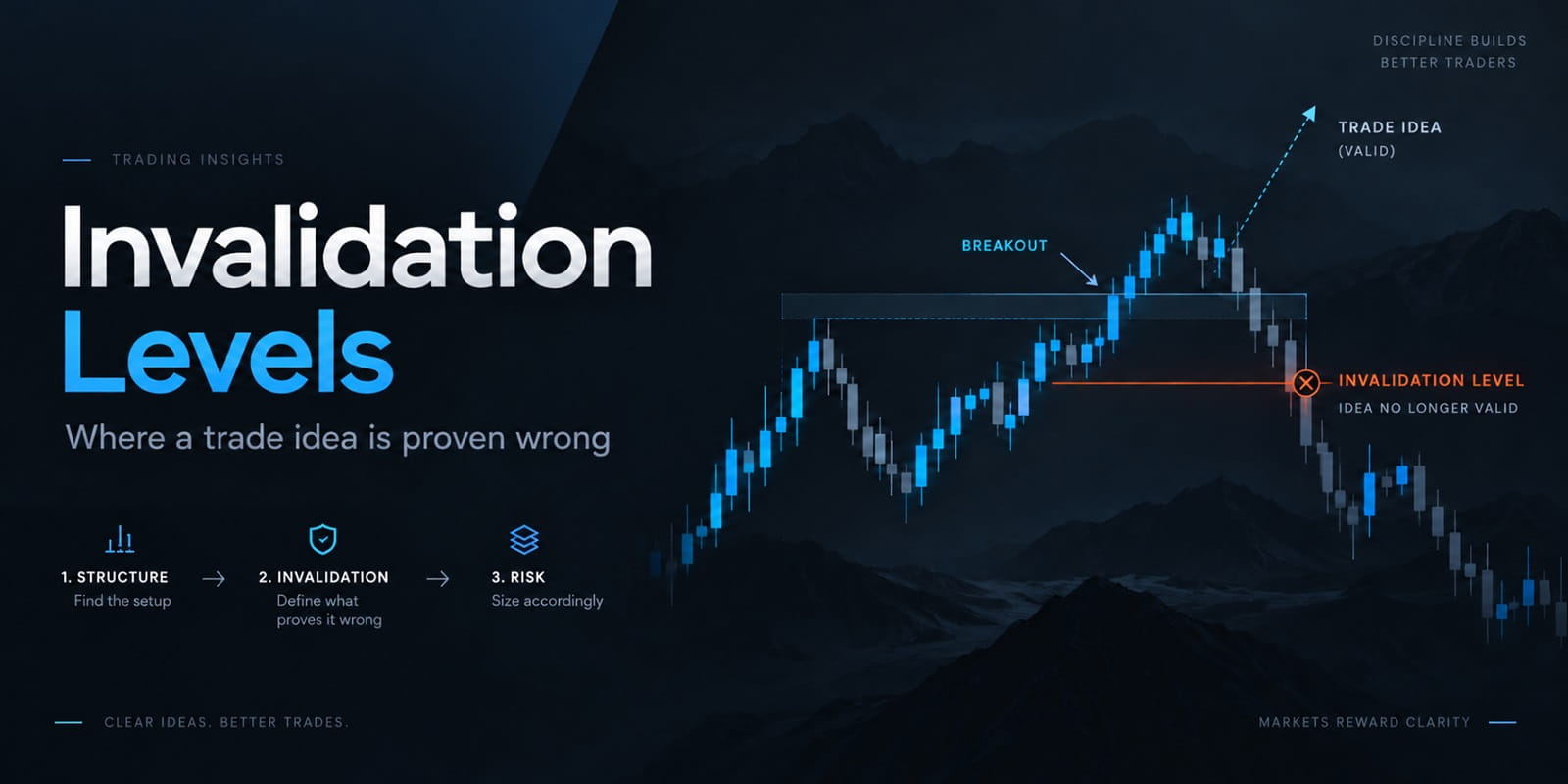
The most important line on any chart isn’t your entry. It’s the point where your idea stops being true. Without it, a losing position turns into hoping, averaging down, or freezing — because you never decided, in advance, what “wrong” looks like.
An invalidation is that decision, made ahead of time and in calm conditions. When it’s hit, you don’t renegotiate with yourself; you act. If you take one habit from Pineva, make it this one: never hold an idea you can’t invalidate. We break down how to define an invalidation level so it protects you instead of trapping you.
A few sharp scenarios beat one confident call
You don’t need dozens of possibilities. You need a clean structure: a primary path (most likely given current conditions), an alternative (what you’d expect if the primary fails), and an invalidation (the line that kills the whole idea). Holding these three at once is what keeps you from being blindsided — whatever the market does, you’ve already met it in your head. That’s the primary / alternative / invalidation framework, and it sits underneath every setup you’ll see in Pineva.
Read the structure, not the noise
Markets generate an endless stream of ticks, headlines and opinions. Very little of it is signal. Thinking clearly means learning to see the underlying structure — the levels, ranges and shifts that actually define where an idea is valid — and letting the rest pass. We cover this in reading market structure, in plain language, without the jargon that usually surrounds it. The goal isn’t to predict the structure’s next move. It’s to know which conditions would change your read.
Put a boundary around the idea
Understanding a setup is only half of a decision. The other half is risk, and it’s non-negotiable. Before acting on any idea, two questions have to be answered in advance: how much to risk on it, and where the stop-loss goes. A good scenario tells you where your thinking breaks; your risk plan tells you what that costs you. Neither is optional, and neither should be improvised once the position is live.
This is why Pineva treats risk as part of the idea, not an afterthought. An idea without a defined risk isn’t a plan — it’s a wish with money attached.
Sometimes the answer is to wait
Here’s the part that separates a method from a habit: quite often, the most disciplined move is to do nothing. If a scenario’s trigger hasn’t fired, if the structure is unclear, if the risk doesn’t justify the reward — waiting is a position. It’s the one no signal service will ever recommend, because patience doesn’t sell. But over time, the trades you skip protect the capital that lets you take the ones that matter.
How this shows up in Pineva
None of this stays abstract. In the futures workspace, each idea is laid out as scenarios with clear triggers and invalidation levels, alongside the context behind them — so you can define your risk and decide with a boundary already in place. In spot research, context and fundamentals come before the position, not after it.
What Pineva will never do is place trades for you or promise you a profit. It gives the structure — research, scenario, invalidation, risk — the space to exist before the pressure of a live market arrives. You stay in control of every decision. Sometimes the most valuable thing the workspace tells you is simply: not yet.
The thread that ties it together
Research before risk. Scenarios, not predictions. An invalidation on every idea. A boundary around every position. The patience to wait when nothing lines up. None of these are advanced techniques — they’re a way of thinking that trades certainty you can’t have for preparation you can.
That’s how Pineva thinks. If it’s how you’d like to think too, you can start free and build your first scenario in a few minutes.
For research and education. Not financial advice. Crypto trading involves risk.