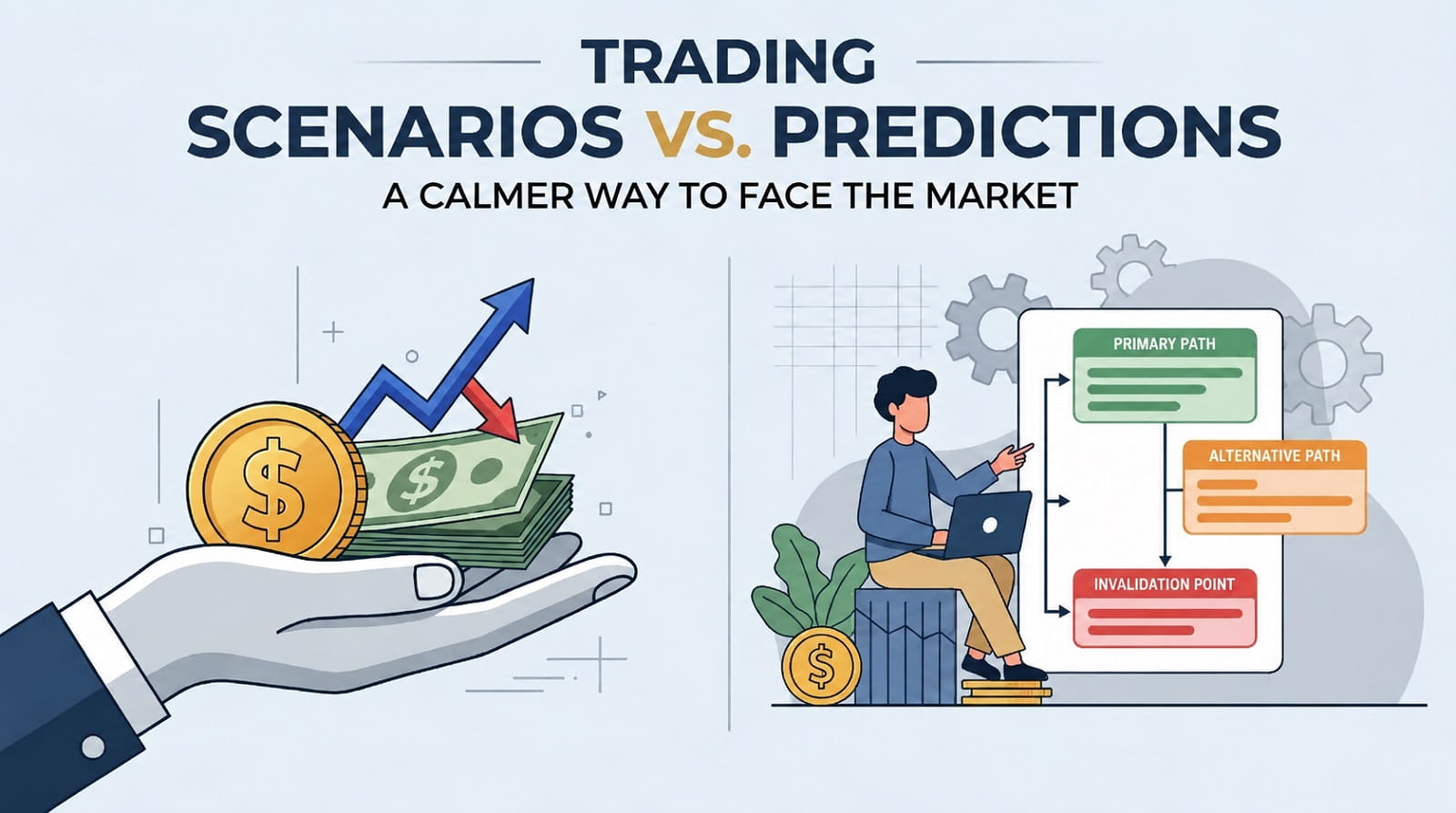
Ask most traders where they’ll get out of a position, and you’ll hear a number that’s really about their wallet: “I’ll cut it if I’m down 10%.” That number feels like risk management. It isn’t. It tells you how much pain someone is willing to take before they quit — and nothing at all about whether the trade idea is still alive. An invalidation level flips that logic around, and building the habit is one of the highest-leverage things a trader can do.
What an invalidation level actually is
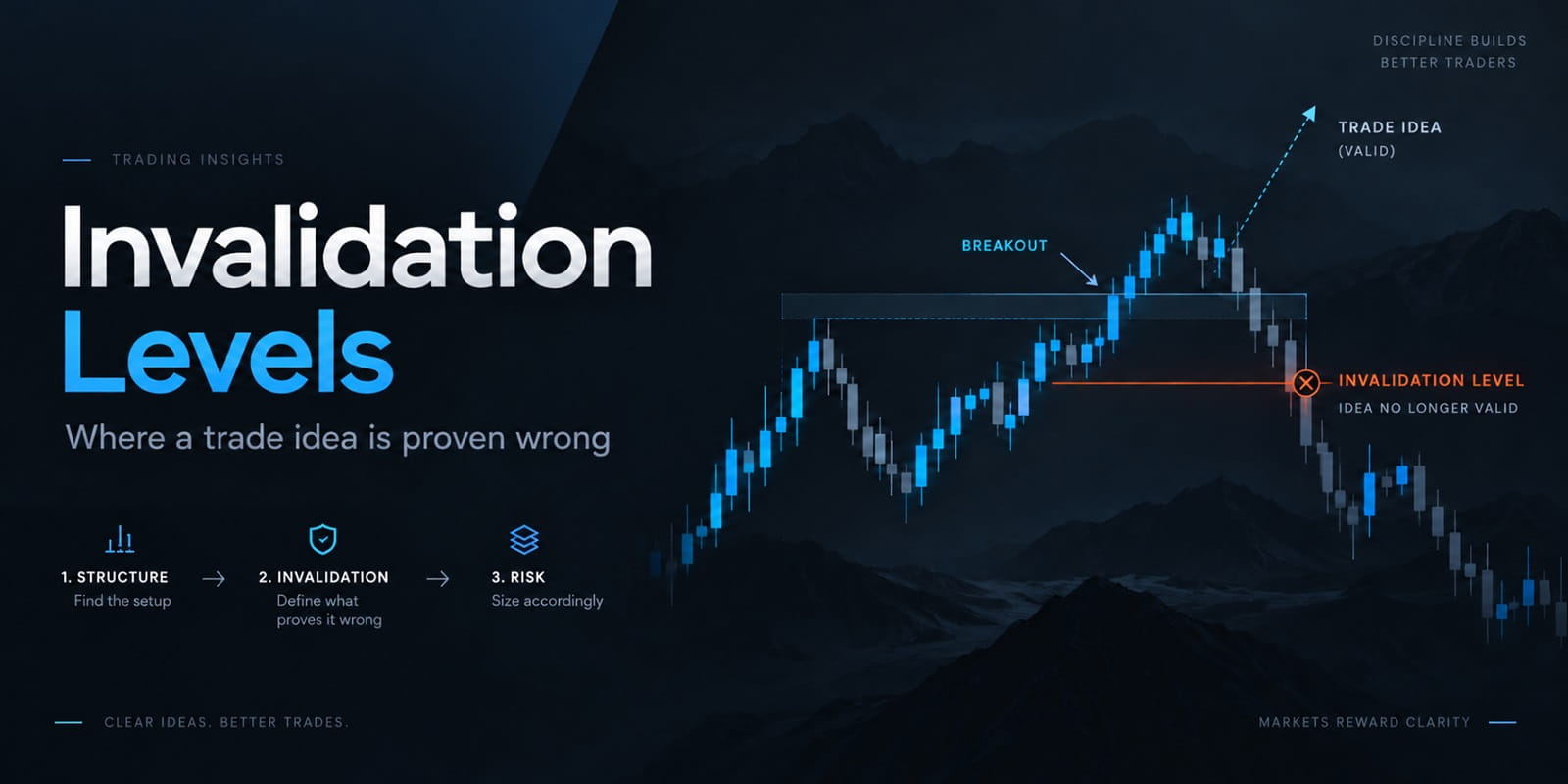
An invalidation level is the price or condition at which your trade idea is proven wrong — chosen before you enter, while you’re still calm. It isn’t “where it hurts.” It’s “where the story I believed is no longer true.”
Every trade rests on a thesis, even a quick one: “this level should hold,” “this breakout should follow through.” The invalidation is the specific, observable point where that thesis fails. Naming it does two things at once. It gives you a clean exit that doesn’t depend on how you feel in the moment — and it forces you, before risking anything, to check whether the trade even makes sense. This is the natural partner to the difference between a scenario and a prediction: a scenario without an invalidation is just a prediction in disguise.
Invalidation vs. stop-loss: not the same thing
These two get used interchangeably, but they’re distinct — and confusing them causes real damage.
An invalidation is a thesis idea: the point where your reasoning breaks. It comes from the chart’s structure. A stop-loss is a mechanical order: the instruction that actually closes the position. The correct order of operations is to find the invalidation first, place your stop-loss at or just beyond it, and then size the position so that being stopped out costs an amount you accepted in advance.
When people skip that order and set a stop based only on “how much I want to lose,” they often drop it into a spot the market touches routinely — inside the noise, nowhere near where the idea actually breaks. They get stopped out of a thesis that was still perfectly valid, then watch it play out without them. The invalidation should define the stop, not the other way around. (For the mechanics of placing and managing a stop-loss, that’s its own topic — here we’re only deciding where the idea dies.)
How to find a good invalidation level
A good invalidation has three qualities:
Structural, not arbitrary. It sits at a level that means something — below a range low, beneath a swing that shouldn’t break if you’re right, past a point that would flip the picture. A round percentage isn’t a structural level; it’s just a number about your account.
Observable and specific. You could describe it to a stranger without pointing at feelings. “If price closes below X” — not “if it starts looking weak.”
Meaningful. If it’s reached, the story genuinely changes. If your idea could comfortably survive the level being touched, then it isn’t your invalidation — you haven’t found the real one yet.
Finding levels like these is a skill in itself, which is why it connects so closely to reading market structure and to the primary / alternative / invalidation framework that organizes a full setup.
A concrete example
Suppose a market has ranged for weeks and you’re eyeing a long. Your thesis: if price reclaims and holds above the range high, the more likely path is a move toward the next level.
Where’s the invalidation? Not “down 8%.” It’s a decisive move back below the range low — because that’s the point where “breaking out” becomes objectively false. The market isn’t just pausing; it’s doing the opposite of your thesis. Your stop-loss goes at or just beyond that level, and only then do you size the position so that, if the stop is hit, the loss is one you’d already made peace with.
Notice the sequence: idea, then invalidation (where it’s wrong), then stop (the order), then size (the cost). Money enters the conversation last — not first. That single reordering is most of what separates a plan from a gamble.
The mistakes that cost the most
No invalidation at all. The position is really just a prediction, and predictions have no off-switch. You drift, and a small loss becomes a large one.
Setting it by wallet, not by structure. Deciding the exit from your account balance instead of the chart puts your stop in the noise and gets you shaken out of good ideas.
Moving it when price gets close. This is the cardinal sin. The entire reason you chose the level in calm conditions was so you wouldn’t renegotiate in the heat of the moment. Widening an invalidation toward hope is how manageable losses turn into the ones people remember.
Too tight or too wide. Too tight and normal fluctuation ejects you for no reason. Too wide and the thesis was dead long before the level — you just paid extra to confirm it.
Why deciding in advance is the whole point
The real value isn’t the level itself — it’s when you choose it. Set in advance, an invalidation is a calm, rational judgment. Set (or moved) mid-trade, it becomes a negotiation with your own fear and hope, which is exactly the state in which people make their worst decisions. You’re not trying to predict whether you’ll be wrong. You’re deciding, ahead of time, what being wrong will look like — so that if it arrives, you simply act.
How Pineva fits
This is why invalidation is a first-class part of every scenario in the futures workspace, not an afterthought you add later. Each idea is laid out with its trigger and its breaking point already defined, in line with how Pineva thinks about scenarios — so the decision about where you’re wrong is made before the market can pressure you into a worse one.
Pineva won’t place the trade for you or promise it’ll work. It just makes sure the most important line — the one where your idea ends — exists before you begin. You can start free and set the invalidation on your first scenario in a couple of minutes.
The takeaway
Your entry decides what you’re hoping for. Your invalidation decides what you’ll accept as being wrong — and the second matters more than the first. Find it from the structure, place your stop by it, size for it, and then leave it exactly where your calm self put it. The invalidation only protects you if you never move it toward hope.
For research and education. Not financial advice. Crypto trading involves risk.