Ask ten people what they think a market will do next, and you’ll get ten confident answers. “It’s going up.” “It’s about to crash.” “This level always holds.” Prediction is the default language of trading — and it’s also one of the quietest sources of stress and bad decisions in the entire field.
There’s a better way to think, and it doesn’t require you to be right about the future. It requires you to be prepared for it. That shift — from predicting the market to mapping scenarios for it — is the single most useful change most traders can make. It’s also the idea Pineva is built around.
The problem with predictions
A prediction is a single-point bet on the future: one price, one direction, one outcome. It feels productive because it’s decisive. But it quietly does three things that work against you.
It hides your risk. A prediction tells you where you think price is going. It says nothing about what happens if you’re wrong — which, for even excellent traders, is a large share of the time. Without a plan for being wrong, “being wrong” turns into hoping, averaging down, or freezing.
It ties your ego to the outcome. Once you’ve predicted “up,” a market going down doesn’t just cost money — it makes you wrong. So you hold, you argue with the chart, you look for reasons the prediction is still alive. The position stops being a decision and becomes an identity to defend.
It has no off-switch. A prediction doesn’t tell you when to walk away. It has no built-in point at which you calmly say, “the idea I had is no longer valid.” So you drift, and small manageable losses become large ones.
None of this is a discipline problem or a knowledge problem. It’s a framing problem. The prediction was the wrong tool.
What a scenario is instead
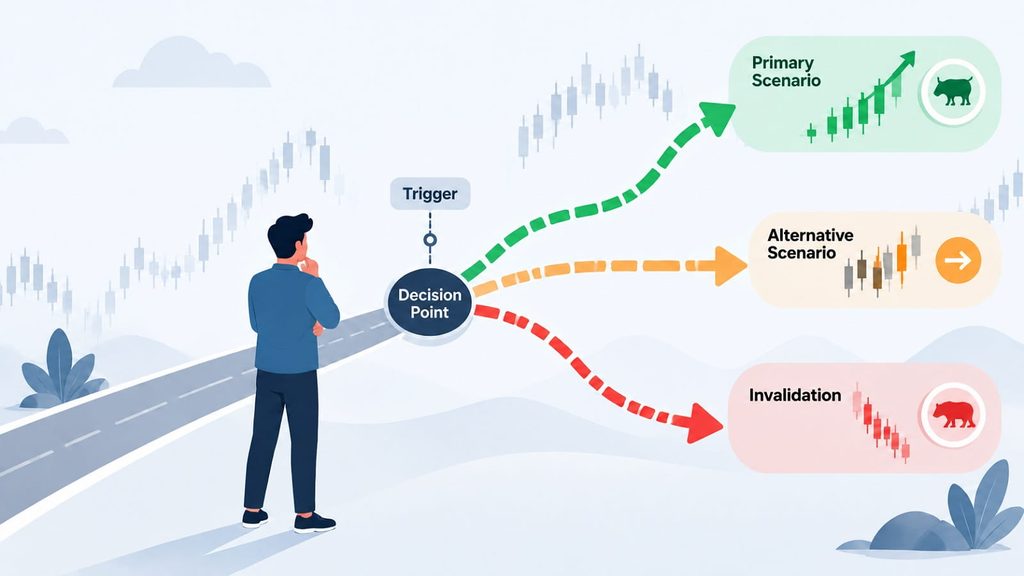
A scenario doesn’t ask what will happen. It asks what could happen, and what I would do in each case. Instead of one prediction, you hold a small set of concrete, conditional paths — each with three ingredients:
A trigger — the specific condition that would put this path in motion. Not a feeling, a condition. (“If price reclaims and holds above X…”)
A path — what you’d expect to unfold if the trigger fires.
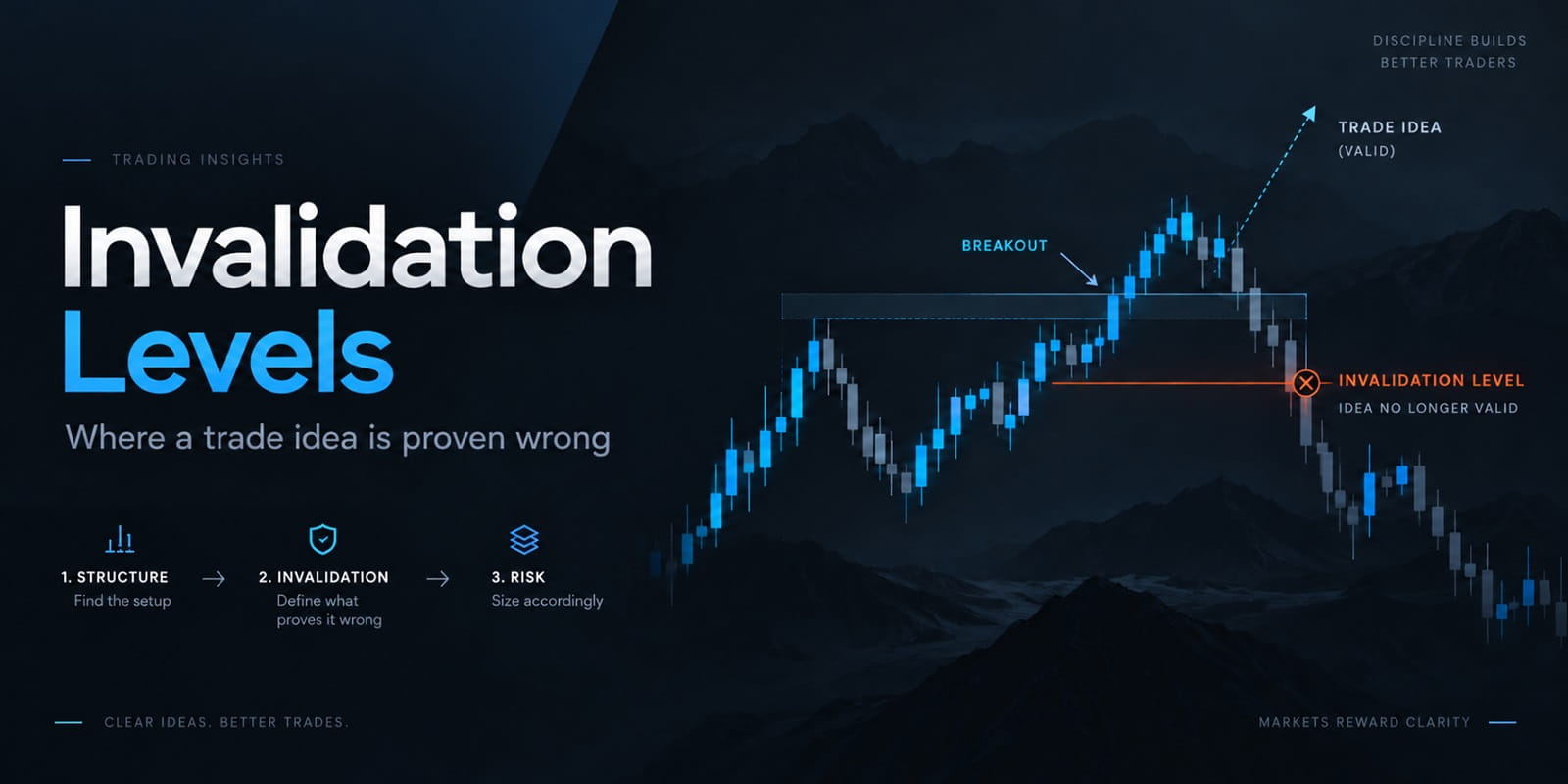
An invalidation — the specific point at which this path is simply wrong, and you’re out. No debate, no hoping.
Notice what this does. The moment you write a scenario, you’re forced to define, up front, the exact conditions under which you’d act and the exact conditions under which you’d stop. Risk isn’t an afterthought you bolt on later — it’s baked into the idea from the first second. That breaking point — what an invalidation level actually is — is worth understanding in its own right, but for now just know it’s the exit condition that every scenario must carry.
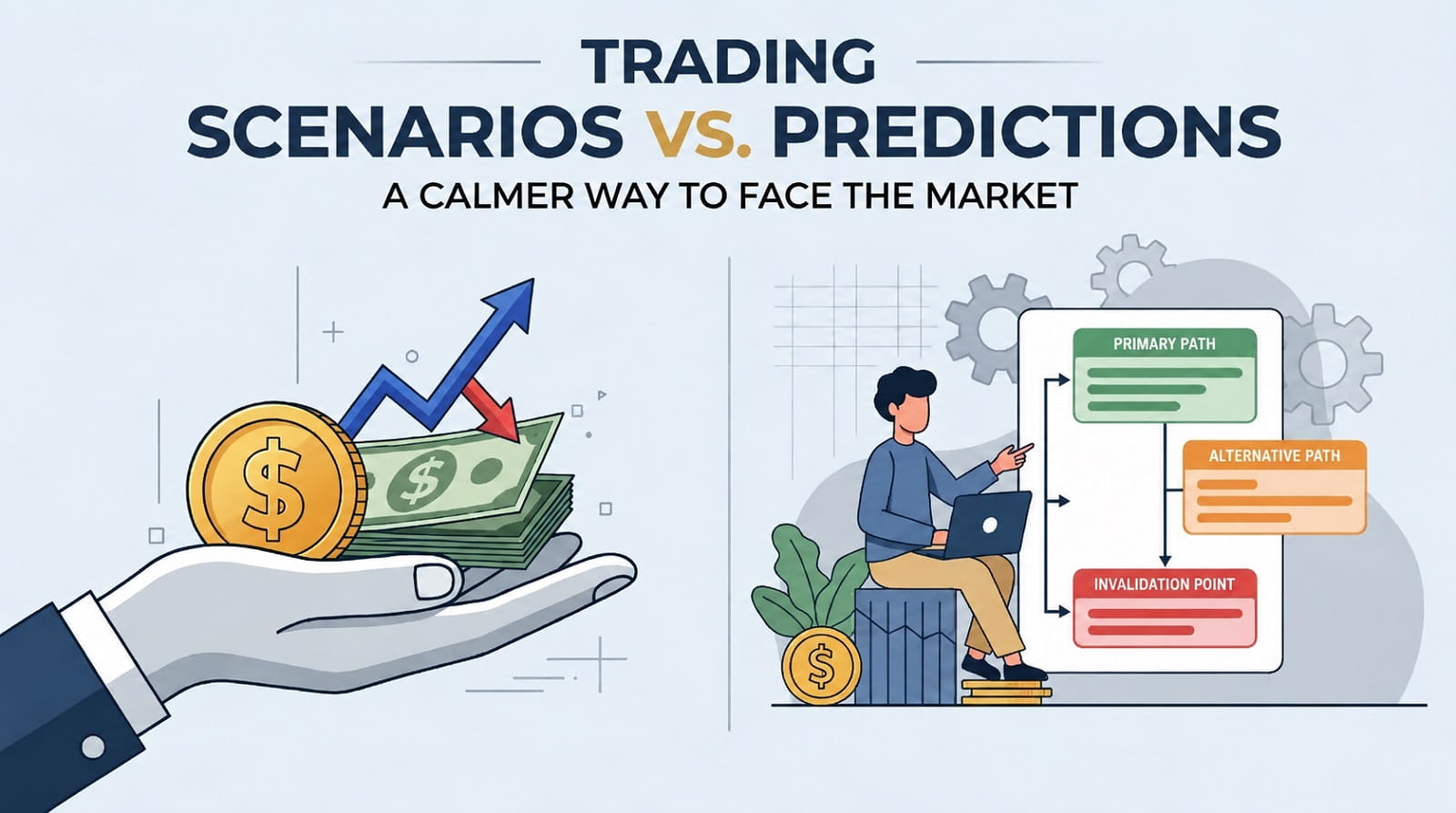
A prediction says: “Price is going up.”
A scenario says: “If price holds above this level on strong volume, the more likely path is toward the next area of interest. If it loses this level instead, that idea is invalid and I’ll step aside. If neither happens, I wait.”
The second version isn’t more complicated. It’s just honest about uncertainty — and honesty about uncertainty is what keeps you calm.
Primary, alternative, invalidation
You don’t need dozens of scenarios. You need a few good ones. A clean structure most disciplined traders converge on looks like this:
The primary scenario is the path you consider most likely given current conditions. It’s your base case — but it’s still conditional, still triggered, still has an invalidation.
The alternative scenario is what you’d expect if the primary doesn’t play out. Crucially, this isn’t pessimism — it’s preparation. When the market takes the alternative path, you’re not shocked and scrambling. You already thought about it. You already know what it means.
The invalidation is the line in the sand. It’s the price or condition that says: the thinking behind this whole setup no longer holds. When it’s hit, you don’t renegotiate with yourself. You act.
Holding these three at once is the antidote to being blindsided. Whatever the market does, you’ve already met it in your head — which is exactly the primary / alternative / invalidation framework that structures every setup.
A concrete example
Suppose a market has been trading in a range for weeks, and you’re interested in it.
The prediction approach: “It’ll break out to the upside.” You buy near the top of the range, hoping. If it breaks down instead, you have no plan — just a losing position and a decision to make in the worst possible emotional state.
The scenario approach looks different:
Primary: “If price breaks and holds above the range high with follow-through, the more likely path is a move toward the next level. I’d consider entering on the retest, with invalidation back inside the range.”
Alternative: “If price rejects the range high and loses the mid-range, the setup is more likely rolling over. I’d stand aside, or look at the short side with its own trigger and invalidation.”
Invalidation for the long idea: “A decisive move back below the range low. At that point the bullish thesis is dead and I’m out, no questions.”
Same market. Same chart. But now every possible move already has a response attached. There’s no moment where you’re frozen, because you did the deciding before the emotion arrived. And before you ever click, you’d also decide how much to risk per trade and set a stop-loss that fits the setup — the scenario tells you where your idea breaks, and your risk plan tells you how much that costs you.
Common mistakes when moving to scenarios
Too many scenarios. If everything is possible, nothing is actionable. Two or three sharp scenarios beat ten vague ones. The goal is clarity, not coverage.
Vague triggers. “If it looks strong” isn’t a trigger — it’s a feeling. A trigger is a condition you could explain to a stranger: a specific level, a specific behavior, a specific confirmation.
Skipping invalidation. This is the most common and most expensive one. A scenario without an invalidation is just a prediction wearing a costume. The invalidation is the part that protects you.
Treating the alternative as failure. The market taking your alternative path isn’t your plan failing — it’s your plan working. You prepared for it. That’s the whole point.
Why this is calmer, not just smarter
Here’s the part people don’t expect: thinking in scenarios doesn’t just make you more disciplined. It makes trading feel different.
When you only have a prediction, every tick that goes against you is a small threat. When you have scenarios, a move against your primary case just means the market is doing something you already anticipated — and you already know what it means. The chart stops being an argument you’re losing and becomes information you’re reading, the same way you can explore market scenarios in the workspace, laid out with their conditions instead of a single verdict.
You’re no longer trying to be right. You’re trying to be prepared. And preparation, unlike prediction, is entirely within your control.
How Pineva fits
Pineva was built around this exact idea — it’s the same principle behind how Pineva thinks about scenarios across the whole workspace. Instead of handing you a single prediction, it lays out market scenarios with clear triggers and invalidation levels, alongside the context behind each one — so you can bring fundamentals and context together and decide with a boundary already in place, before you take on any risk.
It won’t place trades for you, and it will never promise you a profit. What it does is give the structure — scenario, condition, invalidation, risk — the space to exist before the emotion of a live market arrives. Sometimes the most valuable thing that structure tells you is simply: wait.
You can start free and build your first scenario in a few minutes.
The takeaway
Predictions ask you to be right about the future. Scenarios ask you to be ready for it. One puts your ego and your risk on the line every time you’re wrong; the other quietly decides, in advance, what you’ll do in each case — so that when the market moves, you don’t have to panic. You just follow the plan you already made.You don’t need to know what happens next. You need to know what you’ll do when it does
For research and education. Not financial advice. Crypto trading involves risk.