AI Signals use artificial intelligence to analyze market data and identify potential trading opportunities. In crypto trading, these signals help traders assess price direction, entry conditions, and possible exits without manually monitoring every market movement. But a signal is only as useful as the evidence behind it. At Pineva, we believe understanding how a signal is generated, what supports it, and when it becomes invalid matters more than receiving a simple buy or sell alert.
AI Signals for Crypto Trading
AI trading signals are alerts or trade suggestions generated with the assistance of artificial intelligence. They analyze market information and present findings in a format that traders can use to evaluate a potential position.
A crypto AI signal can identify a bullish or bearish setup, highlight a change in market conditions, or suggest price levels worth monitoring. The information provided depends on the system generating the signal.
For anyone comparing AI crypto signals, the first thing to examine is the actual output. A notification saying “Buy Bitcoin” offers less information than a signal that includes the market conditions, entry requirements, invalidation level, and supporting evidence.
Here is what a structured AI trading signal should help you identify.
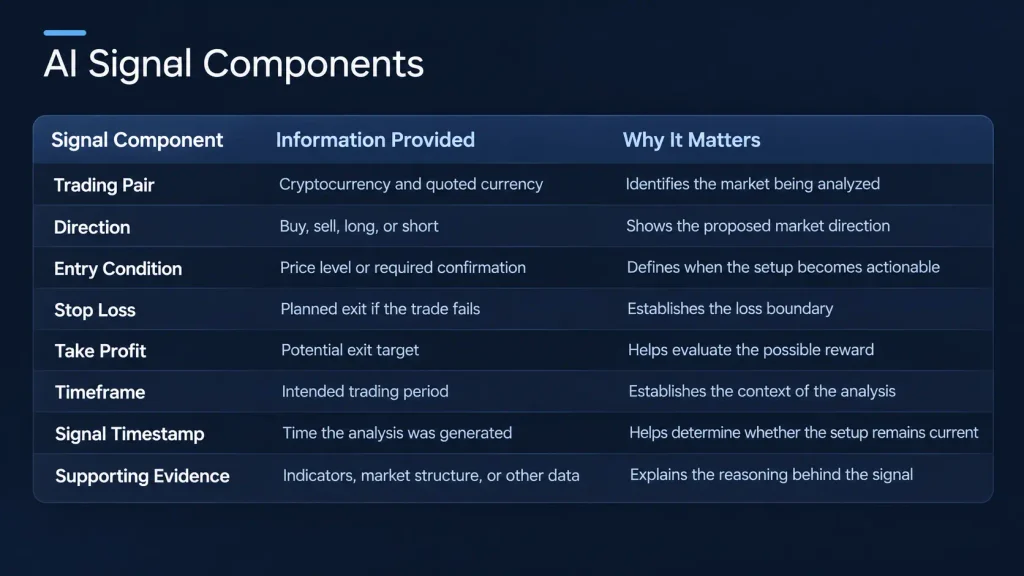
Not every AI signal provider includes all these fields. That difference matters when comparing services because a trading alert without clear conditions leaves essential decisions to the user.
How AI Trading Signals Work
AI powered trading signals begin with data. The system collects information from selected sources, processes that information, and looks for patterns associated with specific market conditions.
For crypto trading, the inputs can include price movements, trading volume, volatility, technical indicators, and historical market behavior. More advanced systems incorporate derivatives data, order book information, or market sentiment from news and other sources.
The process follows three stages.
Data analysis: The system processes selected market inputs and extracts information relevant to its trading strategy.
Pattern identification: Statistical models, machine learning algorithms, or combined analytical methods evaluate the available information against learned relationships or defined conditions.
Signal generation: When the system’s criteria are satisfied, it produces an alert, market classification, or proposed trade setup.
The exact process depends on the technology behind the service. Some products use trained machine learning models. Others combine conventional technical indicators with AI generated explanations.
This distinction deserves attention. Adding an AI label to a traditional indicator does not establish that a system uses machine learning to generate its trading decisions.
We consider transparency about data sources and analytical methods more useful than marketing claims about algorithm complexity.
Types of AI Trading Signals
AI signals serve different purposes depending on the market, trading strategy, and type of information being analyzed.
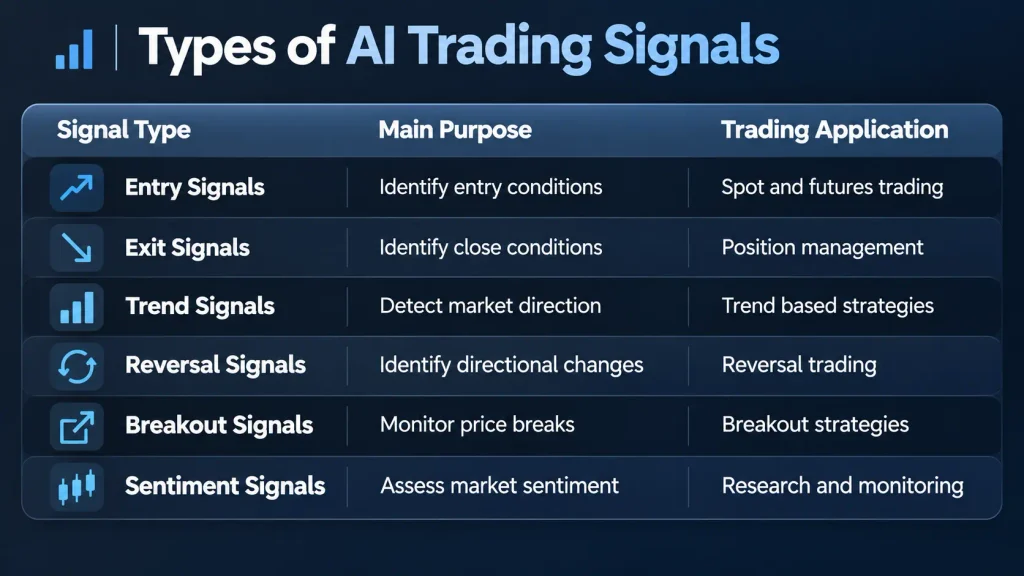
An entry signal and a market sentiment alert should not be interpreted in the same way. One proposes a trading action, while the other provides information that contributes to a broader market assessment.
The distinction is especially relevant in cryptocurrency markets, where spot and futures trading involve different exposure and risk considerations.
For spot trading, AI signals can support decisions about purchasing or selling an asset. In futures trading, signals can describe long or short opportunities, but leverage introduces additional liquidation and position management risks.
Reading an AI Crypto Trading Signal
A trading signal becomes useful when its conditions can be translated into a clear decision.
Consider this hypothetical example for a fictional cryptocurrency trading pair. These numbers are provided only to illustrate how a signal works.
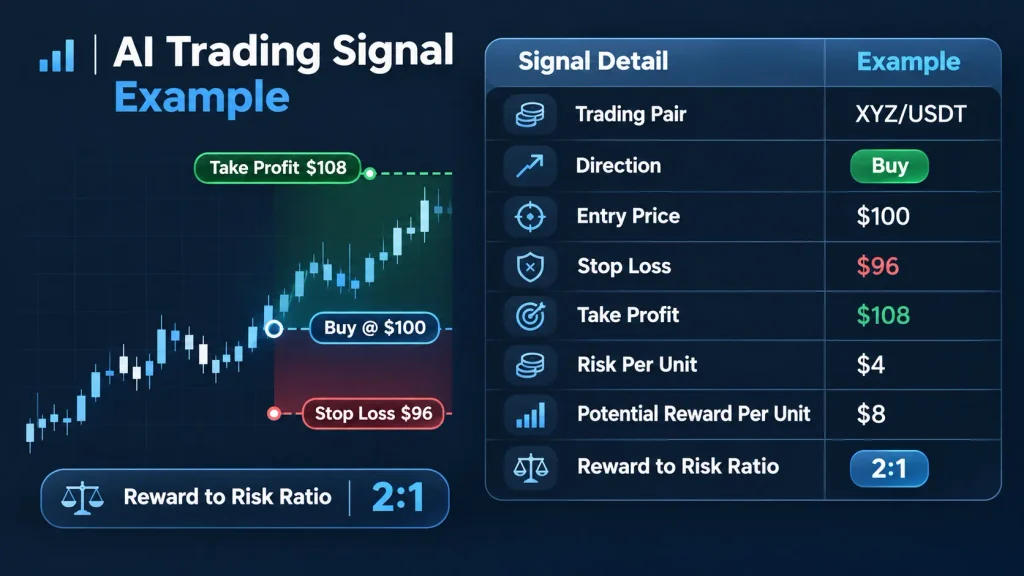
The proposed entry is $100, with a planned loss boundary at $96 and a target at $108. Before trading fees and slippage, the potential reward is twice the defined price risk.
However, the numbers alone do not establish whether this is a valid opportunity.
We would also want to know why the system selected those levels, what market structure supports the direction, and whether the conditions behind the signal are still present.
If the entry price has already moved significantly, the original reward to risk calculation no longer describes the trade available at the current price.
A trading signal must therefore be evaluated as a time sensitive proposal, not a permanent instruction.
AI Trading Signals Accuracy and Reliability
The accuracy of AI generated trading signals depends on their analytical methods, data quality, evaluation process, and market conditions.
No AI model can guarantee the outcome of a cryptocurrency trade. A system that performs well on one historical dataset has not demonstrated that it will produce the same results in a different market environment.
When reviewing a service, we look beyond the headline accuracy percentage.
An 80% win rate, for example, does not automatically mean a profitable strategy. If the losing trades are substantially larger than the winning trades, the overall result can still be negative.
A complete performance assessment needs the number of recorded trades, average gains and losses, trading costs, drawdown, and the conditions under which the results were measured.
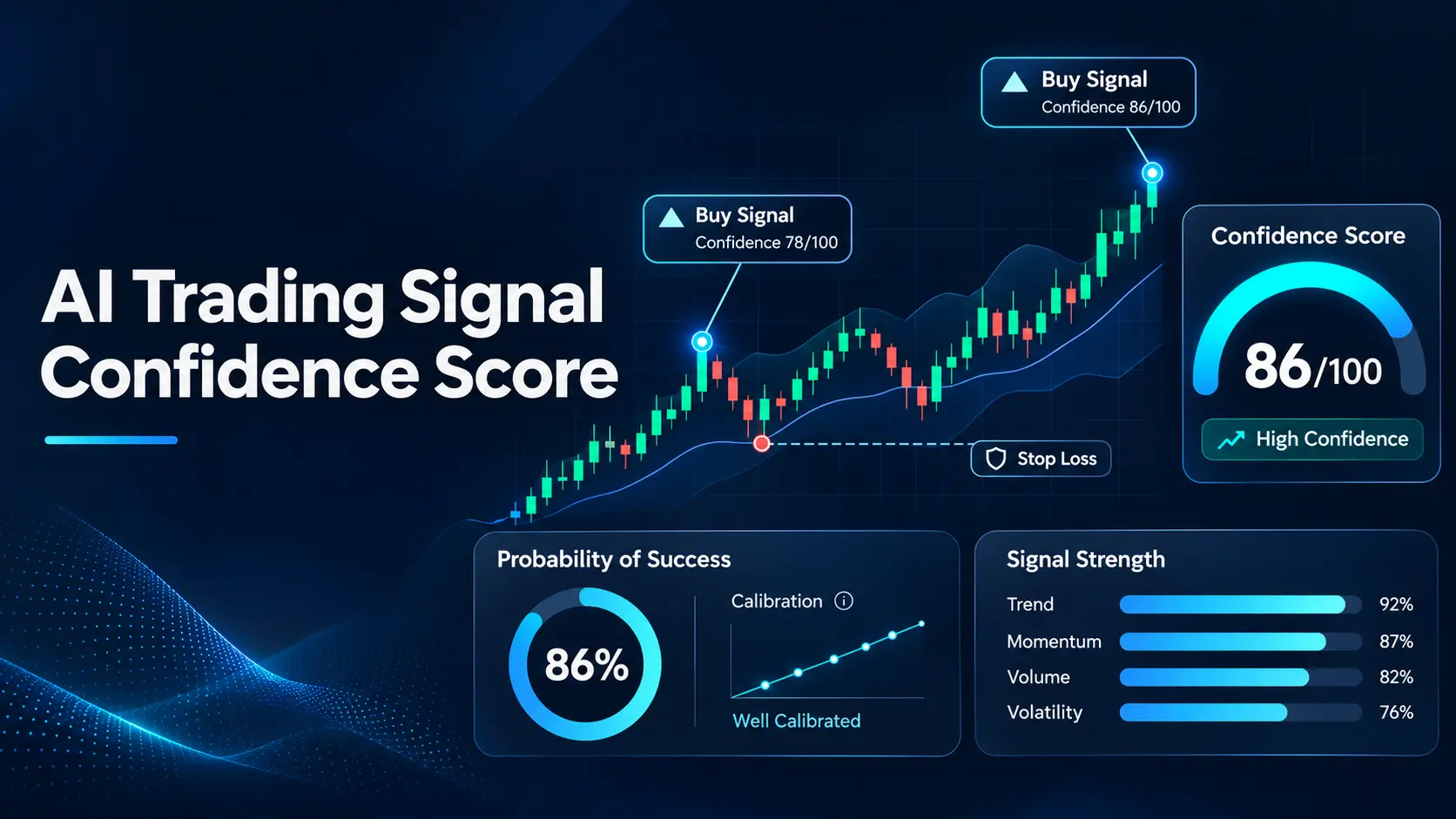
The AI Trading Signal Confidence Score also requires careful interpretation. A displayed confidence value is not automatically a verified probability of profit. Its meaning depends on how the provider defines, calculates, and validates that score.
Historical performance needs the same scrutiny.
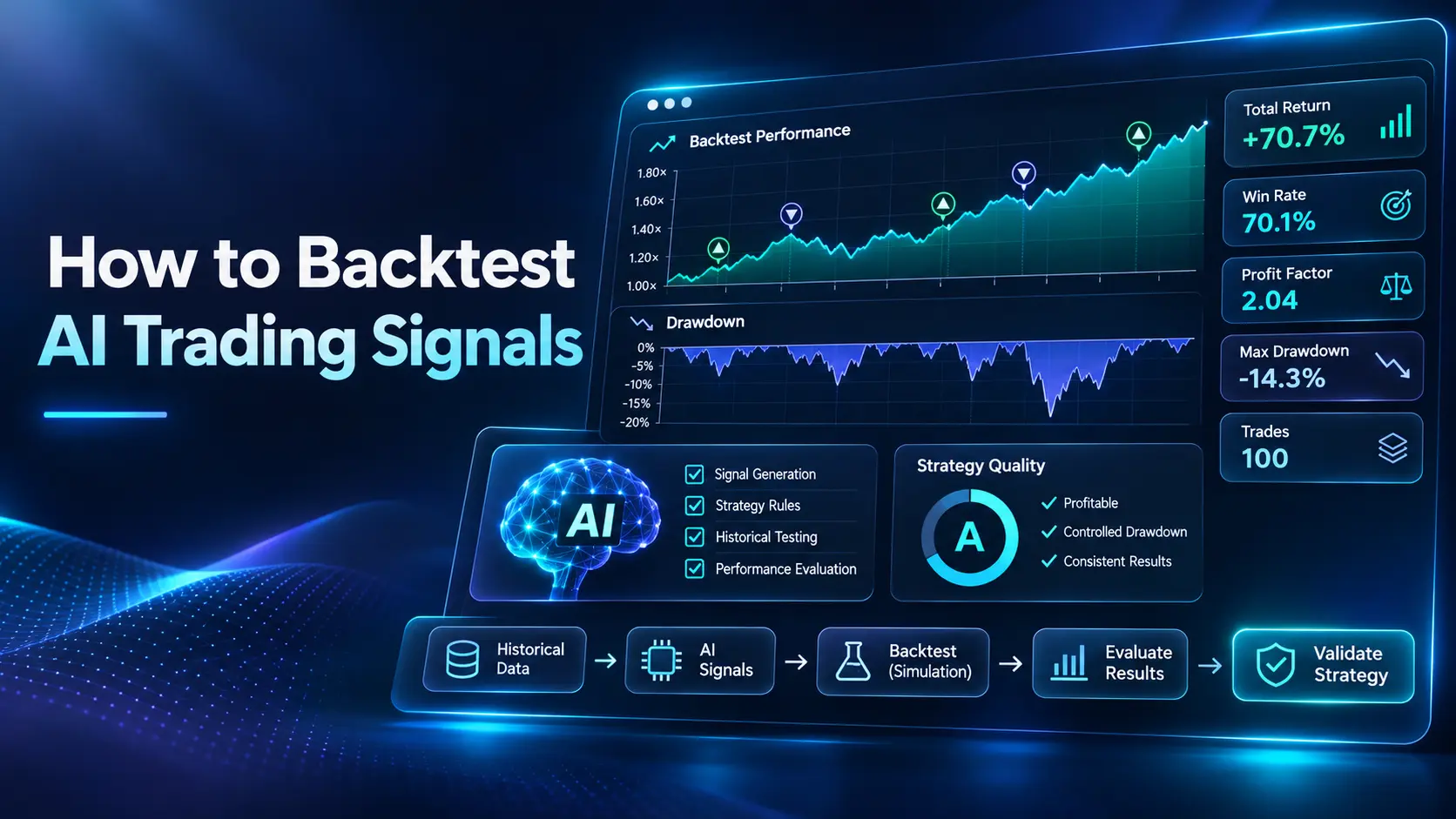
Understanding How to Backtest AI Trading Signals involves examining whether a strategy was evaluated using only the information available at the original decision time. Results produced with future information or unrealistic execution assumptions cannot establish genuine historical performance.
We also distinguish between simulated backtests, forward testing with simulated trades, and records of actual executed positions. These are different forms of evidence and should be reported separately.
Choosing an AI Signals Provider
Finding an AI signals service is straightforward. Determining whether it deserves attention requires a closer look at the information behind its alerts.
We evaluate providers by their transparency, the quality of their signals, and the evidence supporting their performance claims.
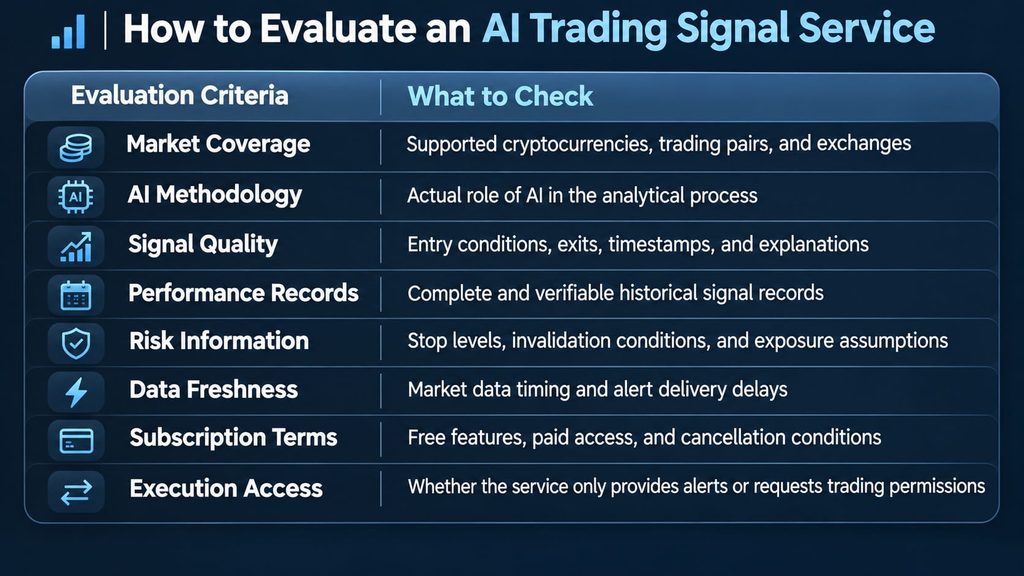
Free AI trading signals are useful for examining a platform’s interface and output format. However, free access alone does not establish the quality of the underlying system.
Paid services require the same evaluation. A subscription price is not evidence of better performance.
One of the most important parts of How to Avoid False Signals in AI Trading is checking whether the market conditions that generated an alert remain valid when it reaches the trader. A delayed notification, outdated dataset, or failed price breakout can leave an otherwise reasonable signal unsuitable for execution.
The provider’s historical records should also include losing signals, canceled alerts, and changes to previously issued recommendations.
A collection of successful screenshots does not establish consistent performance.
AI Signals and Trading Decisions
Artificial intelligence can assist with market analysis, but receiving an AI signal and executing a trade are separate activities.
The distinction in AI Trading Signals vs AI Trading Bots centers on execution. A signal provides information or suggests an action. A trading bot can use programmed instructions and exchange permissions to place orders automatically.
The relationship between AI Trading Signals vs Manual Trading is different. AI processes selected data through models and algorithms, while manual trading relies on human interpretation and decision making. A trader can combine both approaches by using AI generated information as one input in a personally controlled trading process.
For us, the important question is not whether a signal comes from a machine or a human analyst. It is whether the reasoning can be examined and the associated risk can be understood.
A useful decision process establishes the market context, checks the evidence supporting the proposed direction, defines the invalidation conditions, and determines the acceptable exposure before any action is taken.
This also leaves room for rejecting a signal.
A trade that does not meet the required conditions does not become more attractive simply because an algorithm generated it.
Risks and Limitations of AI Crypto Signals
AI systems operate on the information and assumptions available to them. Inaccurate data, incomplete market coverage, and changes in market behavior can reduce the usefulness of their output.
Crypto markets introduce additional complications through volatile price movements, exchange liquidity differences, and the costs associated with executing transactions.
Even a correctly generated alert cannot guarantee that a trader will enter at the quoted price.
Fees, spread, slippage, and futures funding costs affect realized performance. These expenses matter when evaluating short duration strategies with narrow profit targets.
There is also the question of accountability. When a provider advertises exceptional returns without a complete verifiable record, the claim should not be treated as established performance.
Regulators, including the Commodity Futures Trading Commission and the U.S. Securities and Exchange Commission, have warned investors about misleading AI investment claims and promises of guaranteed profits.
We believe a signal provider should make its limitations clear rather than presenting artificial intelligence as a solution to market uncertainty.
Pineva’s Approach to AI Signals
At Pineva, we believe useful market information should support a decision rather than replace the person making it.
Our approach to cryptocurrency analysis is built around research, market structure, conditional scenarios, and risk planning.
Instead of treating one predicted price direction as certain, we emphasize understanding the conditions that support a potential market move and the circumstances that would invalidate the original idea.
This is an important distinction between receiving a ready made trading alert and working through a structured market scenario.
Pineva is a crypto research and decision support workspace, not a signal selling service. It helps users organize research, examine trading scenarios, and plan risk. It does not execute orders or manage customer funds.
AI trading signals can provide information worth considering, but they do not remove the need to understand the market or take responsibility for a trading decision.
Final Thoughts
AI Signals bring automated market analysis into a format that traders can use to identify potential opportunities, monitor conditions, and evaluate trade ideas.
Their value does not come from the AI label itself. It comes from relevant data, clear reasoning, verifiable performance, and transparent risk information.
At Pineva, we see technology as a way to make market decisions easier to examine, not a reason to abandon independent judgment.
The goal is not to follow every signal. It is to understand the evidence well enough to decide which opportunities deserve attention and which should be left alone.
FAQ
Can I use AI signals without connecting my exchange account?
Yes. Services that provide trading alerts without executing orders do not require direct exchange access. Platforms offering automated execution need additional permissions. Users should review every requested permission carefully and avoid granting withdrawal access to signal services.
What if two AI signal tools give me opposite recommendations?
Compare their data sources, timeframes, analytical assumptions, and entry conditions. Opposing recommendations do not automatically mean either system is malfunctioning. Each signal should be evaluated against the market conditions and trading strategy it was designed to address.
Can I use AI signals for long term crypto investing?
Yes, provided the analysis supports the intended investment horizon. Short term trading signals do not establish a long term investment thesis. Long term decisions require additional research into project fundamentals, liquidity, adoption, and financial risk.
Should I trust an AI signal that gets edited after it’s published?
A trustworthy provider should preserve the original signal alongside its subsequent revisions. Changing entry prices, targets, or recommendations after market movements can misrepresent historical performance. Users should look for timestamped records showing the original conditions, modifications, and final results.
Can I use AI signals when I’m completely new to trading?
AI signals can help beginners study market analysis, but they do not replace trading knowledge. Understanding order types, position sizing, and financial risk is essential before committing capital. Simulated trading provides an environment for practicing these skills without exposing real funds to market losses.
Can I follow an AI signal from one exchange on another exchange?
Yes, but the signal must be reassessed using the destination exchange’s market data. Prices, liquidity, spreads, and available trading pairs can differ between exchanges. Entry conditions and risk calculations should reflect the exchange where the trade will actually be executed.
If an AI signal has multiple profit targets, do I need to use all of them?
No. Multiple profit targets represent possible exit levels rather than mandatory instructions. Traders can evaluate each target against their strategy and risk plan. Any decision to close part of a position should account for the remaining exposure, transaction costs, and original trade conditions.
Do more daily AI signals mean the service is better?
No. Signal frequency does not establish trading quality. A provider generating hundreds of alerts can perform worse than one producing fewer, more selective opportunities. Performance should be assessed through complete trade records, net profitability, drawdown, and consistency across different market conditions.
What if my exchange goes offline when an AI signal triggers?
Check the exchange’s operational status and confirm whether any submitted orders were accepted or executed. Do not assume that an order failed simply because the interface stopped responding. Once service is restored, reassess the signal against current prices before taking further action.
Can I use limit orders instead of market orders with AI signals?
Yes, if the signal’s execution conditions allow it. A limit order specifies the maximum buying price or minimum selling price, but execution is not guaranteed. A market order prioritizes execution at available prices, which can result in slippage. The appropriate order type depends on the signal conditions, market liquidity, and trading plan.
For research and education. Not financial advice. Crypto trading involves risk.