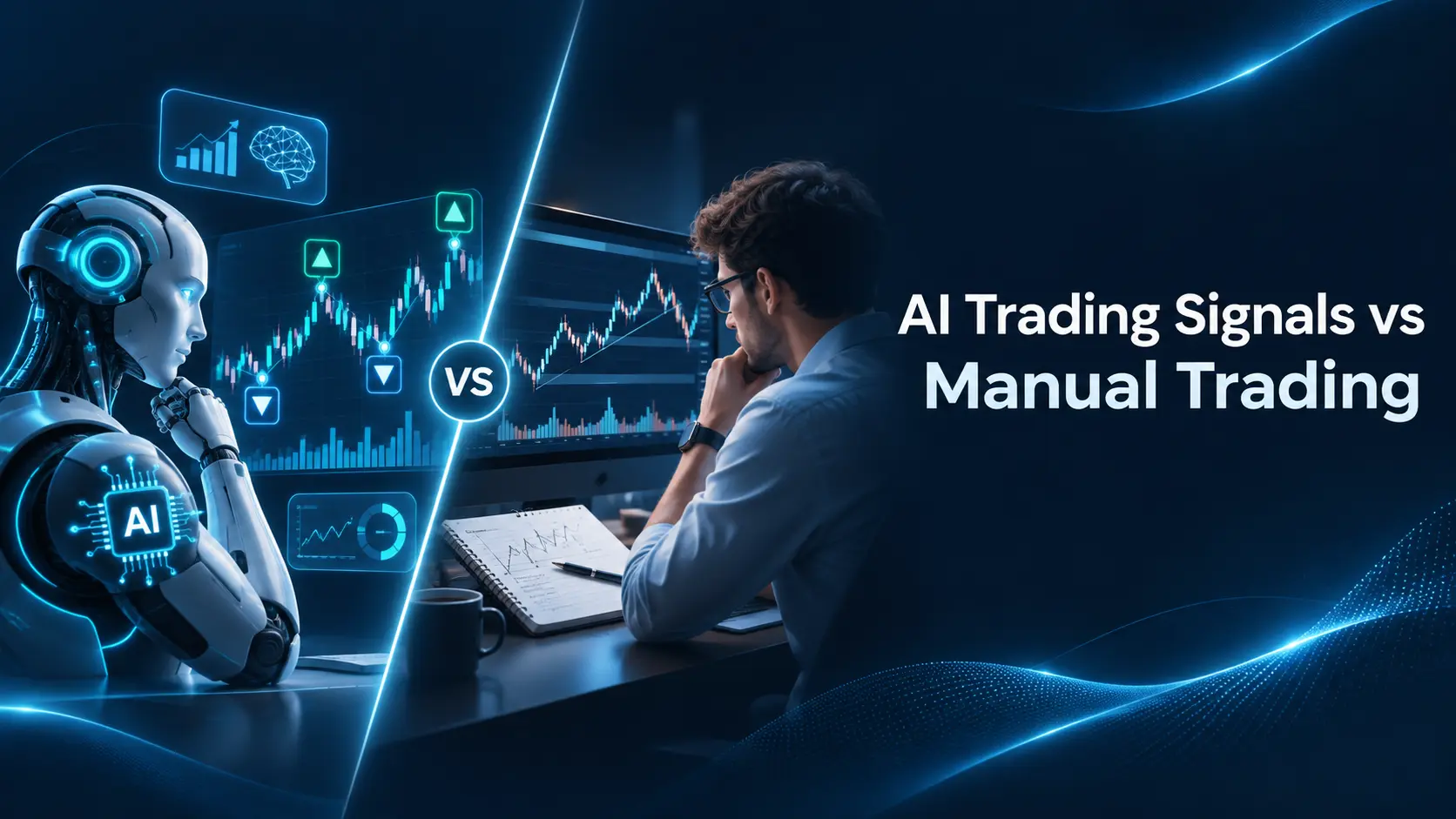
AI trading signals and manual trading offer two different approaches to finding opportunities in the crypto market. AI signals analyze selected market data and generate trading suggestions, while manual trading relies on a trader’s own analysis and judgment. AI can reduce the time spent monitoring charts, but manual trading gives users direct control over how they interpret market conditions. Neither approach guarantees better returns. The right choice depends on trading experience, available time, analytical needs, and risk tolerance.
AI Trading Signals vs Manual Trading: Key Differences
The main difference between AI trading signals and manual trading lies in how opportunities are identified and evaluated. AI systems apply analytical models to market data, while manual traders examine charts, indicators, market conditions, and other information before making decisions.
Both approaches can lead to manually executed trades. Receiving an AI signal does not mean an order will be placed automatically.
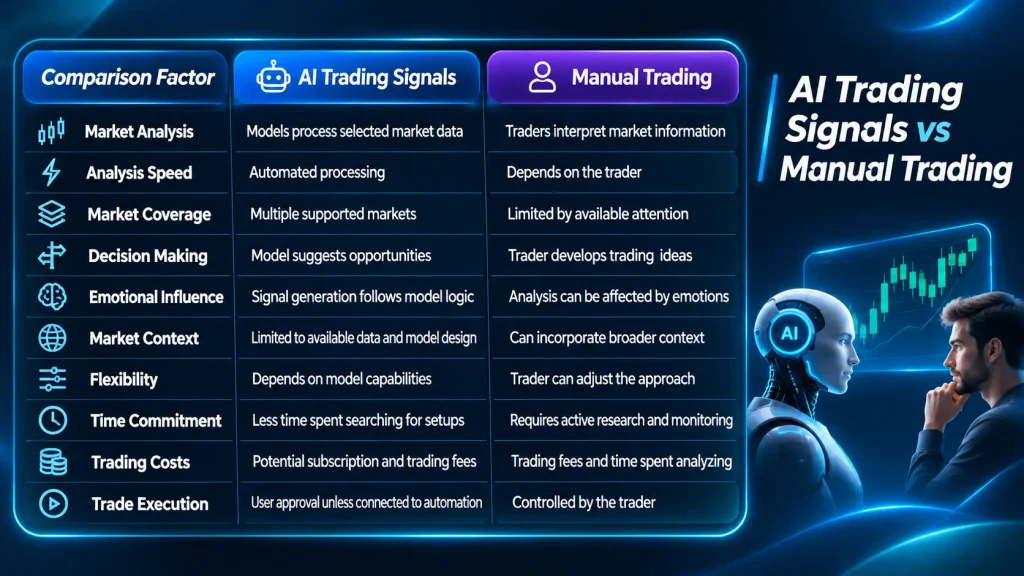
From our perspective at Pineva, the important distinction is not whether a machine or human identifies the opportunity. It is whether the trading idea has clear supporting evidence and whether its risks can be evaluated before execution.
AI Signals and Manual Analysis
Both approaches examine financial markets, but the way they process information is different.
AI Trading Signal Analysis
AI trading systems analyze information according to their programmed methods and available data. Depending on the service, this includes price movements, trading volume, volatility, technical indicators, and other market information.
Machine learning models can identify relationships in these datasets and generate signals when their analytical conditions are satisfied.
The quality of the result depends on the model, its training and evaluation process, and the accuracy of the incoming information.
A signal showing a potential buying opportunity does not establish that the market will rise. It presents an output based on the conditions assessed by the system.
Manual Trading Analysis
Manual traders develop their own market interpretation by examining price structure, technical indicators, news, and other information relevant to their strategy.
They decide which evidence deserves attention, how different factors should be weighted, and whether current conditions justify entering a position.
This allows a trader to consider unusual developments that fall outside the data used by an AI model.
However, flexibility comes with responsibility. Manual decisions depend on the trader’s knowledge, consistency, and ability to follow a defined process.
The practical distinction in AI trading signals vs manual analysis is therefore between model driven evaluation and human interpretation, not between guaranteed accuracy and human error.
Speed, Accuracy and Market Coverage
AI has a clear advantage in processing large quantities of structured information without requiring a person to inspect every chart.
A properly configured system can monitor numerous trading pairs and timeframes, evaluate predefined conditions, and generate alerts when those conditions are met.
Manual trading requires direct attention. A trader cannot examine unlimited markets simultaneously, and the time spent researching one opportunity reduces the time available for others.
Speed, however, is not the same as accuracy.
A model can process information quickly and still produce an unsuitable signal. A manual trader can identify a strong setup and still interpret the evidence incorrectly.
We would not judge either approach by win rate alone. A meaningful comparison requires completed trade records, average profits and losses, drawdown, and results after trading costs.
The comparison must also use equivalent markets, timeframes, and risk assumptions. Otherwise, a difference in reported performance cannot be attributed to the analytical method itself.
Human Judgment and Emotional Discipline
Manual trading allows decisions to incorporate information that a particular AI system does not process.
An unexpected regulatory announcement, exchange disruption, or significant change in market liquidity can influence how a trader evaluates an existing setup.
Human judgment provides flexibility, but it also introduces emotional pressure.
A trader who has experienced several losses can become hesitant about a valid opportunity. After a profitable trade, the same person can become excessively confident and accept risk outside the original plan.
AI signal generation follows the logic implemented in the system without experiencing fear or excitement. That consistency does not mean the system is free from bias.
Models can reflect weaknesses in their training data, analytical assumptions, and historical patterns. When market behavior changes, those assumptions can become less reliable.
The purpose of using technology should be to improve the consistency of analysis while keeping decisions grounded in current evidence.
AI Signals and Manual Trading in a Crypto Setup
Consider a hypothetical cryptocurrency trading at $100, with resistance near $105 and support at $96.
An AI system identifies a potential bullish setup after price approaches resistance. Its model detects conditions associated with a breakout and generates a buying signal.
A manual trader examines the same chart but also checks whether the breakout has attracted sufficient trading activity and whether price can remain above the resistance level.
The two approaches can reach different conclusions even when analyzing the same asset.
The AI Signal Approach
The system evaluates the price action against its analytical criteria. If those conditions are satisfied, it generates an alert with the proposed direction and relevant trading levels.
The trader receiving the signal must still decide whether the opportunity remains valid and fits the intended risk.
The Manual Trading Approach
The trader assesses the price structure directly and decides whether the breakout has sufficient confirmation.
If price briefly exceeds $105 but fails to remain above resistance, the trader can reject the buying opportunity.
An AI system can also be designed to reject failed breakouts. The difference depends on whether that confirmation requirement exists in its model.
This example illustrates an important point: neither method is inherently better at identifying the breakout. The outcome depends on the analytical rules, available information, and decisions made from that evidence.
The prices are fictional and are not current trading recommendations.
Time Commitment and Trading Costs
The financial cost of a trading method is not limited to the price of an analytical tool.
Manual traders invest time in finding opportunities, reviewing charts, maintaining research records, and updating their market assessments.
AI signal services can reduce the time required to search for setups, but users still need to review alerts, monitor their positions, and evaluate the provider’s performance.
A paid signal service adds a subscription expense. Both methods remain subject to exchange fees, spreads, and slippage.
For a trader monitoring several cryptocurrency pairs, automated analysis can reduce repetitive research work.
For someone following a small number of markets with a clearly defined strategy, manual analysis can provide the required information without an additional signal subscription.
We consider the amount of useful work a tool removes more important than the number of features it advertises.
Risk Management and Decision Control
The difference between AI signals vs manual trading becomes particularly important when evaluating the risk of a proposed position.
An AI signal can identify an entry opportunity without knowing the user’s account balance, existing exposure, or acceptable loss.
Manual analysis does not automatically solve that problem either. A trader can understand the market correctly and still choose an unsuitable position size.
In both approaches, the trading decision needs three boundaries: the condition that supports entry, the point where the original analysis becomes invalid, and the amount of capital exposed if the trade fails.
These boundaries should be defined before submitting an order.
At Pineva, we approach crypto analysis through research, conditional scenarios, and risk planning rather than relying on a single predicted outcome.
A trading opportunity becomes more useful when the reasoning behind it can be examined and rejected if the required conditions are absent.
Combining AI Signals With Manual Trading
Choosing between automated analysis and human judgment does not require abandoning either approach.
A combined workflow uses AI Signals to identify potential opportunities while leaving the final assessment and execution decisions with the trader.
This is where we see practical value in combining the strengths of both methods.
The system handles the repetitive work of scanning selected markets. The trader reviews the opportunities that emerge and evaluates them against the current market structure.
A disciplined workflow follows four stages:
- Use AI analysis to identify potential trading setups.
- Confirm the market structure and supporting evidence.
- Define the invalidation point and acceptable position risk.
- Accept or reject the opportunity based on the trading plan.
This approach reduces repetitive chart monitoring without removing personal responsibility for the trade.
It also creates a clear distinction between receiving information and acting on it.
A signal that fails the trader’s own conditions should remain an observation rather than becoming a position.
Choosing the Right Trading Approach
The better choice depends on what the trader needs from the analytical process.
AI trading signals are suited to traders who need broader market monitoring, faster identification of predefined conditions, and less repetitive chart scanning. They are useful when the service provides transparent signals that can be independently evaluated.
Manual trading is suited to traders who prefer developing their own market interpretation, maintaining direct control over analytical decisions, and responding to information outside a model’s available inputs.
For experienced traders, combining AI assisted analysis with manual decision making can provide a practical division of responsibilities.
For beginners, neither method removes the need to understand trading fundamentals, market risk, and position management.
Before choosing a provider or changing an existing strategy, we would examine whether the proposed method solves a specific problem in the current trading process.
Paying for faster analysis has little value if the resulting information cannot be trusted or applied consistently.
Final Thoughts
AI trading signals and manual trading are different ways of approaching the same task: identifying opportunities and deciding whether the available evidence justifies taking a position.
AI offers faster processing and broader market monitoring. Manual trading provides greater flexibility in interpreting context and developing individual trading decisions.
Neither approach guarantees higher returns or eliminates financial risk.
At Pineva, we believe technology is most useful when it helps traders examine opportunities with greater clarity while maintaining control over their decisions.
The goal is not to choose between human judgment and artificial intelligence at any cost. It is to build a trading process where the analysis is understandable, the risk is defined, and every decision has a clear reason behind it.
FAQ
Can I try AI trading signals without risking my own money?
Yes. Signals can be evaluated through paper trading or a simulated portfolio when suitable tools are available. The results should record the original signal time, proposed entry, actual simulated execution, and trading costs. Simulated performance does not guarantee equivalent live trading results.
What if two AI tools give me completely different signals?
Compare the timeframes, input data, market conditions, and analytical objectives of each system. Different outputs can reflect different model assumptions rather than a technical failure. Conflicting signals should not be combined into a trading decision without evaluating their underlying conditions.
Do I need coding skills to start using AI trading signals?
No. Services that provide ready to use trading alerts do not require programming knowledge. Users still need sufficient trading knowledge to interpret the signal, understand its risk, and evaluate whether the provider’s methodology is credible.
Can I use AI signals from one exchange to trade on another?
Yes, but the trading conditions must be reassessed using the destination exchange’s data. Prices, liquidity, spreads, and available instruments can differ between exchanges. The original entry and exit levels should not be assumed to produce identical execution results.
Can I stop using AI signals and return to manual trading whenever I want?
Yes, when using a service that only provides information and does not control order execution. Canceling a signal subscription does not automatically close existing positions or cancel exchange orders. Any active trades must still be managed through the relevant trading account.
For research and education. Not financial advice. Crypto trading involves risk.