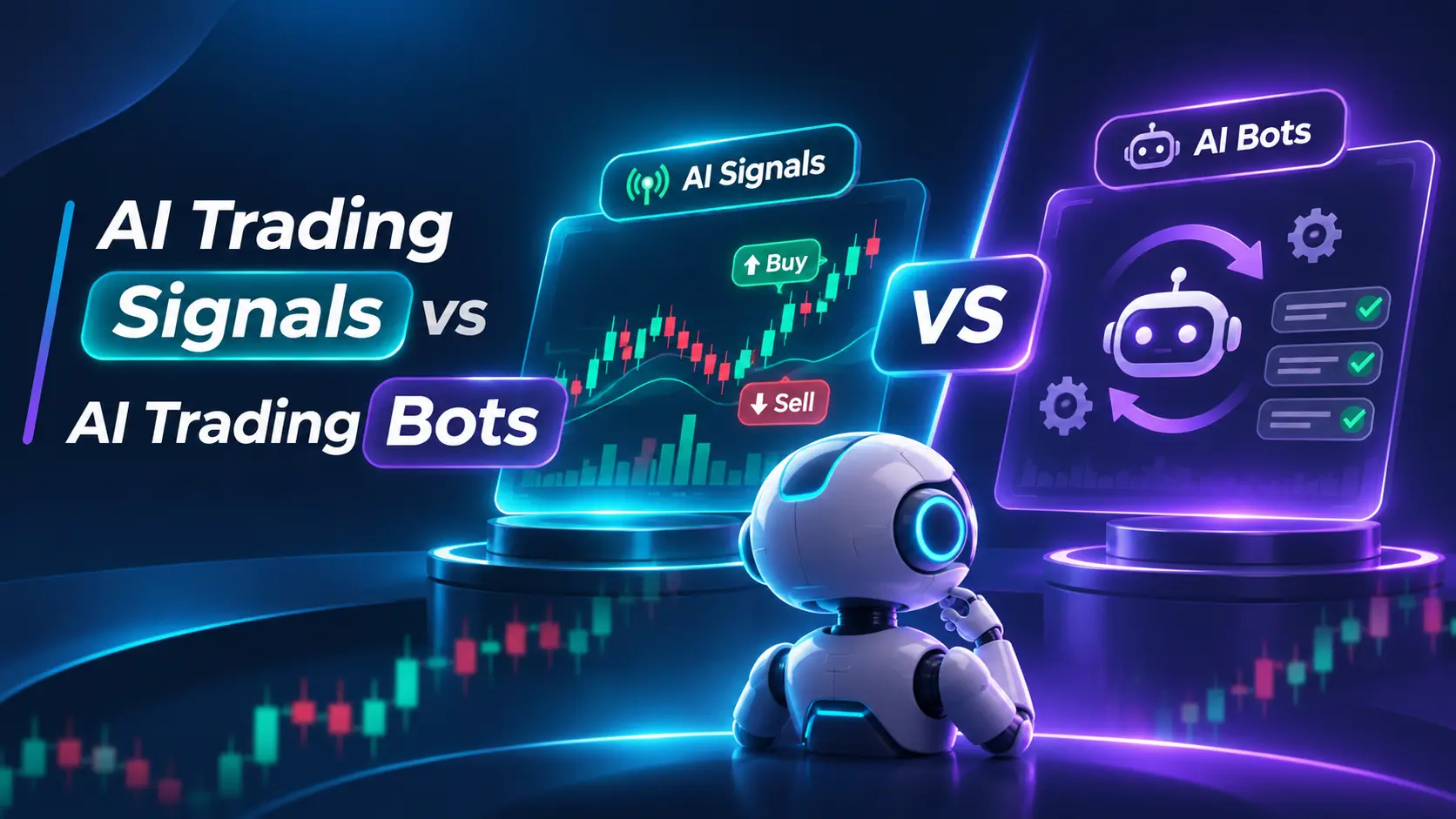
AI trading signals and AI trading bots both use technology to support crypto trading, but they serve different purposes. Signals identify potential opportunities and leave the trading decision to the user. Bots can execute orders automatically according to configured rules or model outputs. The better choice depends on how much control you want, how often you trade, and whether your strategy needs human judgment or automated execution.
AI Trading Signals vs AI Trading Bots: Key Differences
The biggest difference between AI trading signals and trading bots is who executes the trade. With signals, the trader reviews the information and decides whether to act. With a bot, the system can place orders without waiting for individual approval.
That distinction affects everything from trading speed to account security.
| Feature | AI Trading Signals | AI Trading Bots |
| Primary Function | Identify trading opportunities | Execute trading strategies |
| Trade Execution | Manual by default | Automated |
| Trader Control | Individual trade approval | Control through settings and limits |
| Market Monitoring | Automated analysis and alerts | Automated monitoring and execution |
| Execution Speed | Depends on trader response | Depends on system and exchange latency |
| Exchange Connection | Not required for alerts | Required for live automated trading |
| Technical Setup | Lower complexity | Greater configuration requirements |
| Main Risk | Acting on inaccurate or outdated signals | Automatic execution of unsuitable trades |
| Best Suited For | Traders who prefer reviewing each trade | Traders with tested, repeatable strategies |
Neither approach guarantees better trading performance. A signal can identify an opportunity that fails, while a bot can execute an unsuitable strategy with perfect consistency.
There is another distinction worth understanding: not every trading bot uses artificial intelligence. A bot following fixed technical rules is an automated trading system, even if its provider advertises it alongside AI products.
How AI Trading Signals and Bots Operate
AI trading signals turn market analysis into information that traders can review before taking a position.
A signal can contain a proposed direction, entry conditions, an invalidation level, and potential exit targets. The trader evaluates these details against current market conditions before deciding whether to place an order.
A trading bot works differently. It monitors defined conditions and performs the actions permitted by its configuration. Depending on the platform, those actions include opening positions, submitting exit orders, adjusting orders, and closing trades.
The bot does not need to be built around machine learning. Its execution rules can come from technical indicators, predefined price levels, or an external AI model.
For us at Pineva, this distinction is essential when evaluating trading technology. The analytical method and the execution method are separate decisions. A sophisticated signal does not automatically make an execution system reliable, and fast execution does not make an inaccurate signal profitable.
AI Signals and Trading Bots in a Real Trading Setup
Consider a hypothetical BTC/USDT setup. The market is approaching a resistance level, and a trading system identifies a potential breakout opportunity.
The proposed conditions are:
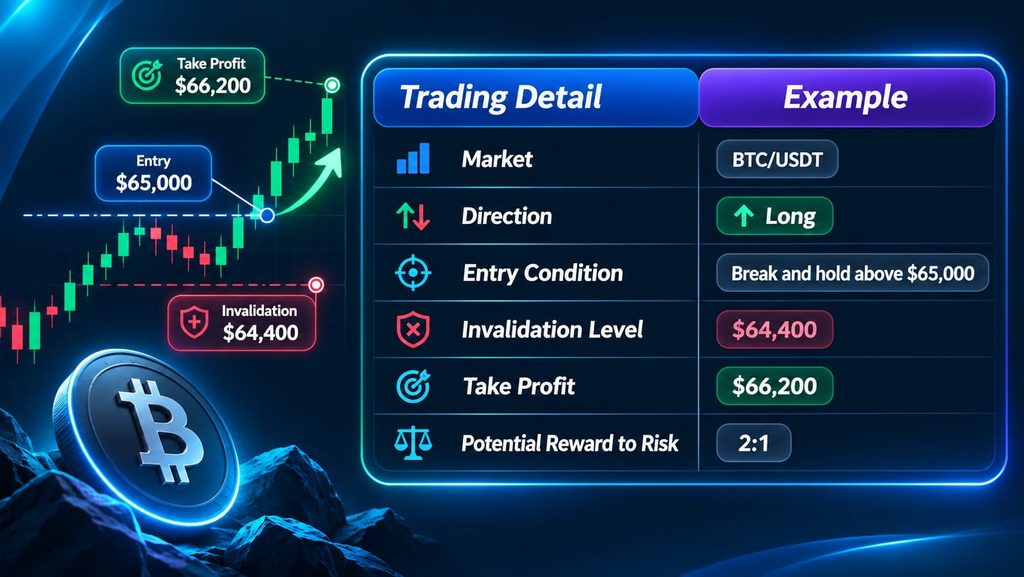
These prices are fictional and illustrate how the two systems handle the same trading idea.
Using AI trading signals
The system detects the required conditions and sends an alert. The trader checks whether the breakout remains valid, reviews the available reward and risk, and decides whether to enter.
If the price has already moved beyond the planned entry, the trader can reject the opportunity.
Using an AI trading bot
The bot monitors the same conditions. If its programmed requirements are satisfied, it can submit the entry order and associated risk management orders through the connected exchange.
The order is executed according to the configured instructions and the exchange’s available liquidity, without requiring a separate manual decision.
Both systems begin with the same trading setup. The difference is how the setup becomes an actual trade.
Trading Control and Automation
Manual approval gives signal users an opportunity to consider information outside the original analysis. News, changing market structure, and unexpected price movements can influence whether a proposed trade remains reasonable.
Automated execution removes that approval step when the bot has permission to trade independently.
This creates an operational advantage for strategies that depend on consistent execution. A bot can monitor multiple markets without waiting for a trader to read a notification.
However, automation cannot correct a weak strategy by itself.
If the system continues receiving valid triggers under its configured rules while the market environment changes, it can continue placing trades that no longer fit the original strategy assumptions.
We consider control settings just as important as the analytical model behind an automated system. Position limits, maximum exposure, permitted trading pairs, and conditions for stopping execution need to be established before activating a bot.
Trading Speed and Market Monitoring
Crypto markets operate continuously, making monitoring requirements an important part of the decision.
A signal provider can analyze markets around the clock, but a manually executed trade still depends on when the user receives and acts on the alert.
An automated bot can respond without that delay, provided its infrastructure, exchange connection, and execution permissions are functioning.
Speed alone does not determine execution quality.
An order submitted immediately can still encounter slippage, insufficient liquidity, partial execution, or rejection by the exchange.
For strategies that rely on precise entry conditions, both signal delivery time and actual execution price need to be considered.
This is why we distinguish between detecting a trading opportunity and successfully executing it. They are related stages, but they are not the same result.
Costs and Technical Requirements
The cost of AI trading signals and trading bots extends beyond the advertised subscription price.
Signal services can charge for access to alerts, advanced analysis, additional markets, or performance information. Trading bots can charge for software subscriptions, supported exchange connections, execution features, or strategy management.
Both approaches also involve exchange trading fees, spreads, and potential slippage.
An automated system introduces additional operational requirements. Users need to configure the strategy, define trading permissions, establish exposure limits, and monitor execution records.
The practical comparison should account for three expenses: the service itself, the cost of executing trades, and the time required to operate it.
A lower subscription price does not establish a lower total cost. A strategy generating more transactions can accumulate greater trading expenses regardless of whether those trades are entered manually or automatically.
Risk Management and Exchange Security
The most important risk difference is not that one method loses more money than the other. It is how an unsuitable decision reaches the market.
With a manually executed signal, the trader can reject a recommendation before placing an order.
With an automated trading bot, the system can execute repeated trades until its configured limits or stopping conditions intervene.
For automated execution, we consider these controls essential:
- Define the maximum permitted position size and total account exposure.
- Establish stop conditions and acceptable loss limits.
- Restrict the bot to approved markets and trading activities.
- Enable exchange API permissions only for the actions the bot requires.
- Monitor execution records and maintain a way to disable further trading.
Exchange API permissions deserve particular attention.
Trading access allows a connected application to submit orders on the user’s account. Withdrawal permissions provide a different and more sensitive level of access.
A trading bot should not receive withdrawal permissions when those permissions are unnecessary for its operation. IP restrictions and account security measures should also be enabled where supported.
At Pineva, our approach to AI Signals places risk information beside the trading idea rather than treating it as something to consider after entry.
A trading system becomes more useful when its limitations are visible before capital is committed.
Combining AI Trading Signals With Trading Bots
Choosing between signals and bots does not require using only one approach.
A hybrid setup can separate market analysis from order execution.
For example, an AI signal provider can generate alerts based on selected market conditions. A connected execution bot can then receive those alerts and place orders according to predefined trading permissions and risk limits.
This creates a process with three distinct responsibilities:
Signal generation: Identify a potential market opportunity.
Trade validation: Check whether the signal satisfies the strategy’s entry and risk requirements.
Automated execution: Submit the permitted orders after the required conditions are satisfied.
The validation stage is particularly important. Automatically executing every received alert transfers the signal provider’s errors directly into the trading account.
A hybrid system should also prevent duplicate orders, reject outdated signals, and account for orders that were submitted but not successfully executed.
These controls determine whether combining signals and automation produces a manageable trading process.
Choosing Between AI Signals and Trading Bots
The right choice depends on the trading process you want to follow, not simply on which technology sounds more advanced.
| Trading Preference | More Suitable Approach |
| Reviewing every trade before execution | AI Trading Signals |
| Monitoring opportunities without giving trading access | AI Trading Signals |
| Executing a tested strategy automatically | Trading Bots |
| Managing repetitive orders across multiple markets | Trading Bots |
| Keeping human approval before automated execution | Signals with controlled automation |
| Combining external analysis with programmed execution | Hybrid Setup |
For traders developing their market analysis skills, manually reviewing signals creates an opportunity to examine the reasoning behind each setup.
For traders operating a tested strategy with clearly defined conditions, automation can improve execution consistency and reduce the need for continuous manual monitoring.
However, neither choice removes responsibility for evaluating performance, managing exposure, and deciding when a strategy should no longer be used.
The better tool is the one whose operating model matches the strategy and the level of control the trader intends to maintain.
Final Thoughts
AI trading signals and AI trading bots address different stages of the trading process. Signals provide information for evaluating opportunities, while bots can turn defined conditions into executed orders.
For traders who value individual trade approval, signals offer greater direct control. For strategies built around repeatable rules and automated execution, bots provide operational flexibility.
At Pineva, we believe that the quality of a trading decision depends on the reasoning behind it, the conditions that invalidate it, and the risk accepted before execution.
The technology used to deliver or execute that decision matters, but it cannot replace those foundations.
FAQ
Can I test an AI trading bot without putting real money in?
Yes. A bot can be tested in a simulated trading environment when the platform supports paper trading or a test network. This allows users to review order behavior and strategy performance without committing real funds. Simulation results do not guarantee identical execution in live markets.
What happens if my trading bot loses its internet connection?
The result depends on where the trading logic operates and which orders have already reached the exchange. Orders accepted by the exchange can remain active, while instructions running only inside the disconnected bot may stop functioning. Users should verify open orders and positions after connectivity is restored.
Can I stop a trading bot immediately after it opens a position?
A bot can be paused or disabled through its available controls, but stopping the software does not automatically cancel exchange orders or close existing positions. Those actions must be confirmed separately in the exchange account.
Can a trading bot use signals from another platform?
Yes, if the platforms support compatible integrations or an external execution interface. The bot must be configured to interpret the incoming signals correctly, validate their conditions, and apply the intended risk limits before submitting orders.
Do AI trading bots need programming knowledge?
Not all of them. Platforms with visual configuration tools allow users to create and operate predefined strategies without writing code. Custom trading algorithms, complex integrations, and advanced execution systems require additional technical knowledge and testing.
For research and education. Not financial advice. Crypto trading involves risk.