Most people buy a coin for one of two reasons: the price is moving, or someone they trust mentioned it. Both are ways of buying on hype. Crypto fundamental analysis is the alternative — buying on understanding. It’s the work of figuring out whether a project is actually worth owning before you put money into it, and it’s the spot-market side of scenarios, not predictions: research first, conviction second, risk last. This page is the map of how to do it.
What crypto fundamental analysis is
Fundamental analysis asks what a project is worth and whether it can succeed — as opposed to technical analysis, which asks where the price might go and when. In stocks, fundamentals mean earnings and balance sheets. In crypto, they mean the project’s purpose, the people building it, how the token is designed, whether anyone actually uses it, and what could go wrong. You’re not trying to predict next week’s candle. You’re deciding whether this is something you’d be comfortable holding at all.
Why it matters more in crypto than almost anywhere
Crypto has a lower barrier to launching a token than almost any market in history, which means the ratio of noise to substance is enormous. Thousands of projects exist mainly to sell tokens; a minority are building something real. Fundamental analysis is how you tell them apart — and it’s also what gives you the conviction to hold through volatility. If you bought on hype, every dip is terrifying; if you bought on understanding, a dip is just a price. Research doesn’t remove risk, but it makes the risk one you chose on purpose.
What to check before you buy
A complete look at a project covers a handful of dimensions. None is sufficient alone; together they build a picture:
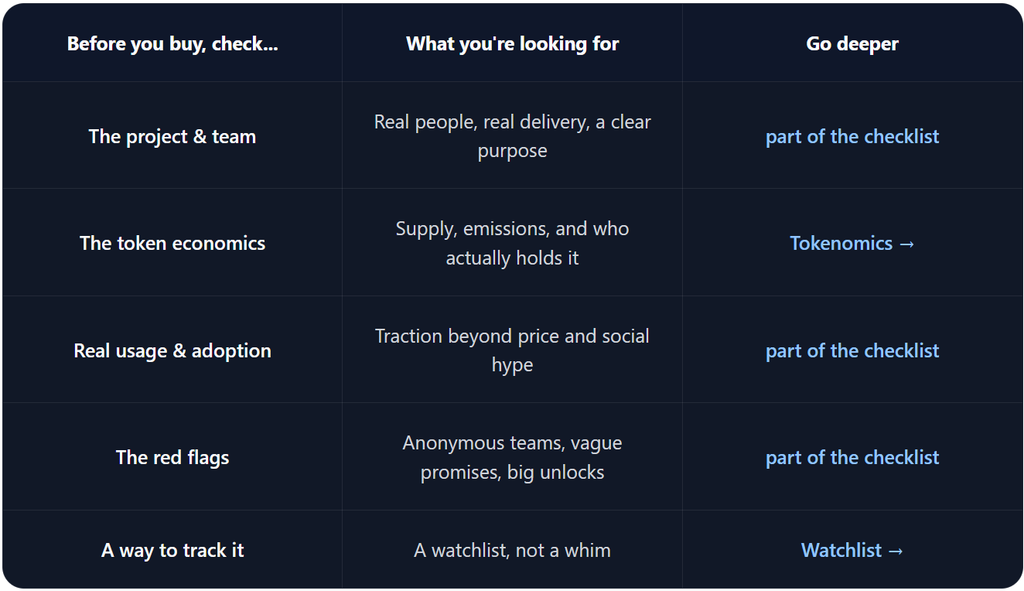
The first, third and fourth rows are the heart of a full research checklist you can run on any project; the token economics and the watchlist each deserve their own deeper guide.
The project and the team
Start with the simplest questions. What problem does this project claim to solve, and does that problem actually need solving — or blockchain to solve it? Who is building it: are they public, credible, and shipping, or anonymous accounts making big promises? A real project has a purpose you can explain in a sentence and a team you can hold accountable. If the pitch is all price and community and no product, that’s not a project, it’s a token.
The token economics
Even a great product can be a poor investment if the token itself is badly designed. How many tokens exist, how many will exist, who holds them, and what unlocks are coming that could flood the market? A small “circulating supply” beside a huge future supply is a classic trap. This is a deep enough topic that it gets its own guide — the token economics — but even a shallow look here saves a lot of pain.
Adoption, and the red flags
Look for signs of real use that aren’t just price: active users, real volume, developers actually building, integrations that exist. Then, deliberately, look for reasons not to buy — anonymous teams, guaranteed returns, pressure to buy now, copied whitepapers, tokenomics that only reward early insiders. Good research spends as much energy trying to reject a project as to justify it. The trade you talk yourself out of is often the best one you’ll ever make.
Research tells you what; risk tells you how much
Fundamental analysis answers whether to own something and with how much conviction — it does not tell you how much to put in. Even your highest-conviction research still runs into how much to risk on it: a great project bought with a reckless position size is still a reckless trade. Research and risk are two separate decisions, and you need both — the same principle behind crypto risk management: understand first, then size.
Fundamental vs. technical analysis
These aren’t rivals; they answer different questions. Fundamental analysis tells you what is worth owning. Technical and structural reading tell you when and at what price to act. A strong project can still be a bad entry today, and a weak one can bounce for a while. Serious spot investors use fundamentals to build a shortlist of things they’d be glad to own, then use timing and risk to decide how and when — which is why the last dimension in the table above is simply keeping a watchlist.
How Pineva fits
The spot research workspace is built for exactly this: gathering the context, fundamentals and watchlist for a project in one place, so the decision to buy comes after understanding rather than before it. Pineva won’t tell you a coin will go up or hand you a rating — it gives the research the room to happen so your conviction is your own, not borrowed from a chart or a chat group.
You can start free and research your first project properly instead of on a hunch.
The thread that ties it together
Buy on understanding, not on hype. Check the project, the team, the token economics, the real adoption, and the red flags — and let a strong reason to walk away outweigh a dozen reasons to hope. Keep the ones that pass on a watchlist, decide how much to risk separately, and act on timing when it comes. Do the research first, and every decision after it is yours instead of the market’s.
For research and education. Not financial advice. Crypto trading involves risk.