Your risk-to-reward ratio is the quiet number that decides whether a trading approach makes money over time — and most beginners barely think about it. They chase a high win rate, assuming “being right more often” is the goal. But you can be right most of the time and still lose money, and wrong most of the time and still profit. The difference is the ratio, and it sits at the center of crypto risk management.
What the risk-to-reward ratio is
The risk-to-reward ratio compares what you stand to lose on a trade with what you stand to gain. If you risk $100 to make $300, that’s a 1:3 ratio — one unit of risk for three of reward. The “risk” side comes from the distance to where the stop-loss goes, and the “reward” side from the distance to your target. It’s a simple division, but it reframes every trade around one honest question: is what I might gain actually worth what I’m putting at risk?
Why it beats win rate
Here’s the part that surprises people. With a good enough ratio, you can lose more trades than you win and still come out ahead. Say you risk 1 to make 3 (1:3). Even if only 30% of your trades win, the winners more than pay for the losers. Meanwhile, a trader winning 70% of the time at 1:0.5 (risking 2 to make 1) can quietly bleed out. Win rate feels like the scoreboard; the ratio is what’s actually being scored.
The break-even win rate for each ratio
Every risk-to-reward ratio has a break-even win rate — the percentage of trades you’d need to win just to not lose money. Anything above that line is profit. This single table is worth memorizing:
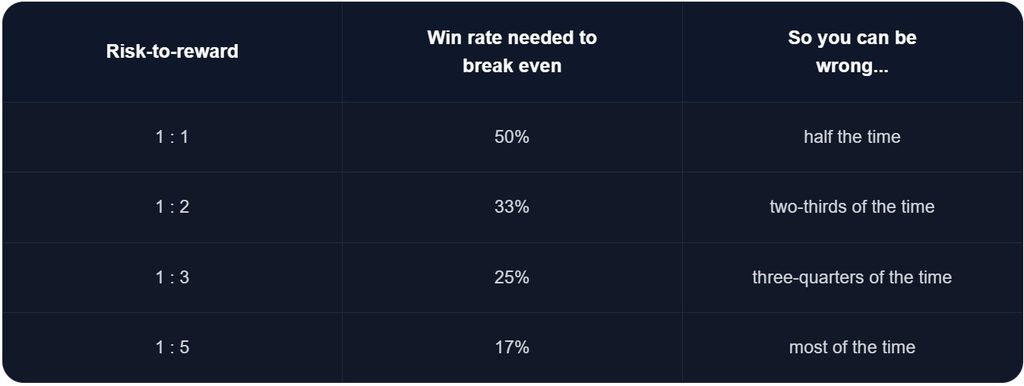
Read the last column again: at 1:3, you can be wrong three times out of four and still break even. That’s why disciplined traders hunt for high-ratio setups instead of trying to be right constantly.
What counts as a “good” ratio
There’s no single magic number, but many traders won’t take a setup below roughly 1:2 — the potential reward should be at least double the risk. Below 1:1 (risking more than you aim to make) is usually a bad trade no matter how confident you feel, because the math is working against you from the start. Higher ratios like 1:3 or more are excellent when they appear, but don’t force them; a realistic 1:2 you actually reach beats a fantasy 1:5 that never gets there.
How to use it before a trade
The ratio turns into a filter you apply before entering. First mark your invalidation level to define the risk, then identify a realistic target to define the reward, then divide. If the ratio clears your minimum, the setup passes this test; if it doesn’t, you skip it — no matter how good it looks. Only after it passes do you size the position. The ratio decides whether to trade; sizing decides how much.
Common mistakes
Chasing win rate. Optimizing to “be right” pushes people into tiny targets and huge stops — a high win rate with terrible economics.
Moving the target to justify the trade. Inflating the reward with an unrealistic target just to make the ratio look good is lying to yourself with math.
Ignoring realism. A great ratio to a level price will never plausibly reach isn’t a great trade. The target has to be believable, not just favorable.
Great ratio, no discipline. None of this helps if you close winners early out of fear. The ratio only pays off if you hold the trade to its plan — which comes down to following your own plan.
How Pineva fits
In the futures workspace, the risk and the target sit on the scenario together, so the ratio is visible before you commit rather than something you rationalize afterward. Pineva won’t tell you a trade will win — it makes the trade-off between what you’re risking and what you’re chasing explicit, so a bad-ratio setup is obvious for what it is.
You can start free and check the ratio on your first setup in seconds.
The takeaway
Stop asking how often you can be right and start asking whether each trade is worth it. A risk-to-reward ratio of 1:2 or better means you can lose more than half your trades and still profit — which takes the pressure off being right and puts it on being selective. Define your risk from the stop, set a realistic target, divide, and only take the setups where the reward genuinely justifies the risk. Do that consistently, and the win rate stops mattering nearly as much as it feels like it should.
For research and education. Not financial advice. Crypto trading involves risk.