Almost every trader knows they should use a crypto stop-loss. Far fewer know where to put one — and that gap is where most of the frustration lives. Set it wrong and you get stopped out right before the trade works; skip it and one bad move erases weeks of progress. The good news is that placing a stop well isn’t guesswork. It follows directly from crypto risk management, and once you see the logic, it’s hard to unsee.
What a stop-loss really is
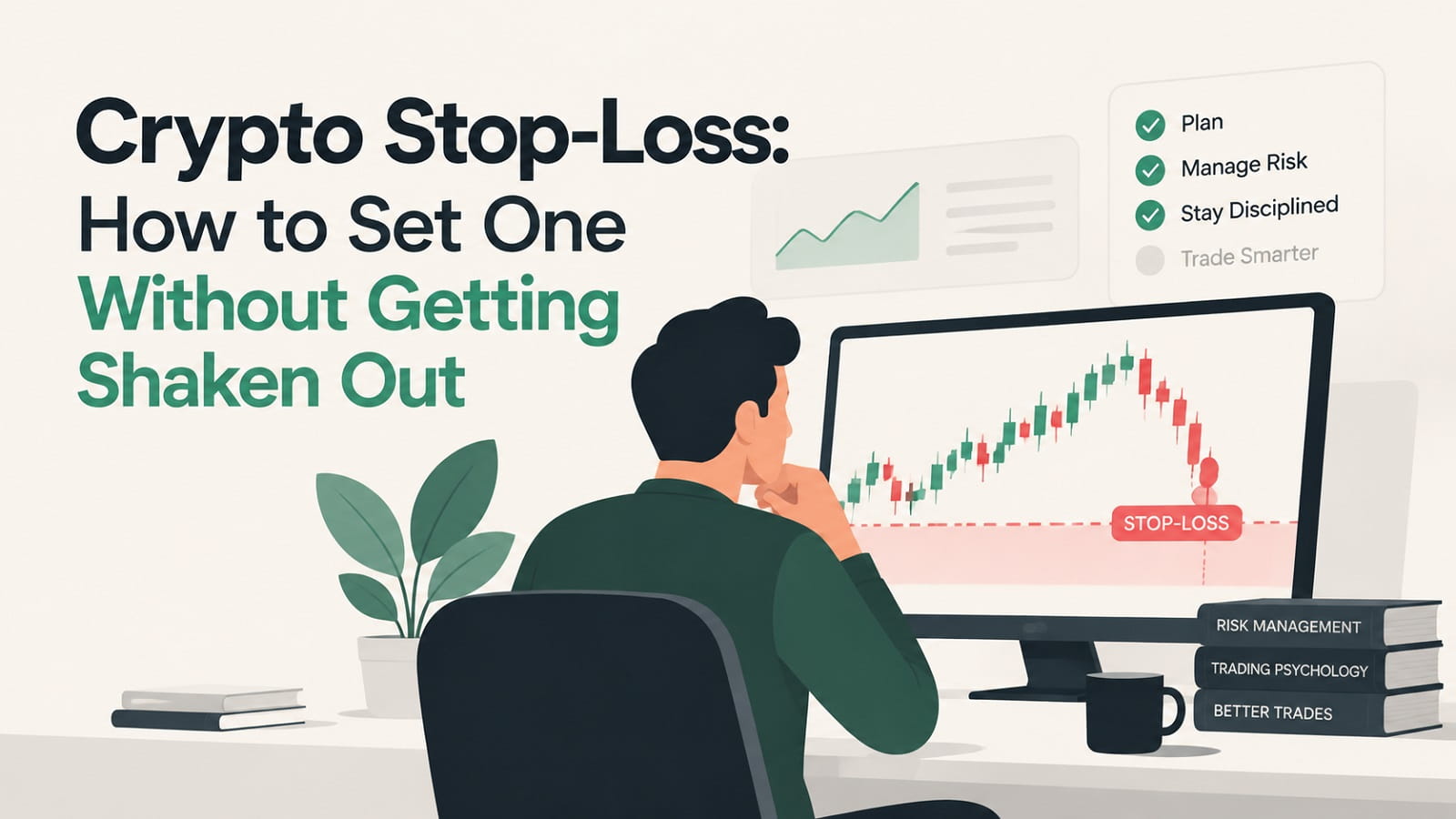
A stop-loss is a standing order that closes your position once price reaches a level you chose in advance. That’s the mechanical definition. But its real job is psychological: it makes the decision to exit while you’re calm, so you don’t have to make it in the panic of a live market moving against you. A stop isn’t an admission you’ll be wrong — it’s the plan for what you’ll do if you are.
The mistake almost everyone makes
Most traders place a stop based on how much they’re willing to lose: “I’ll set it 5% down.” It feels responsible, but it’s backwards. The market doesn’t know or care about your 5%. A stop placed at an arbitrary number lands wherever it lands — often right inside the range of normal price movement, which is why people get “shaken out” and then watch the trade go exactly where they thought. The fix is to place the stop at your invalidation level — the point where your idea is genuinely wrong — not at a round number pulled from your account balance.
Structural vs. arbitrary stops
Every stop is one of two kinds. One respects what the market is actually doing; the other ignores it:
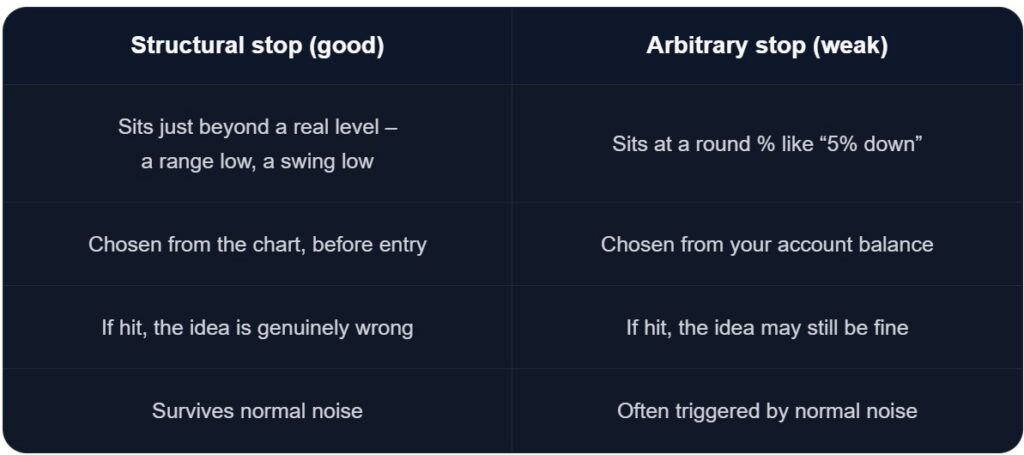
To place a structural stop you have to be able to read the structure — to see the levels that actually matter, so your stop sits just past one of them rather than in the middle of nowhere.
How to place one, step by step
The process is short and always in this order:
1. Define the idea. Know your scenario and its trigger before anything else.
2. Find the invalidation. Identify the structural level that, if broken, proves the idea wrong.
3. Place the stop just beyond it. A little past the level, not exactly on it, so a marginal wick doesn’t eject you.
4. Size to the stop. Now measure the distance from entry to stop and size the position so that being stopped out costs only your fixed risk (say 1%). The stop distance sets the size — never the reverse.
Should you ever move a stop?
Yes — but only in one direction. Moving a stop to lock in profit as a trade works in your favor (a “trailing” stop) is disciplined. Moving a stop further away because price is approaching it and you don’t want to be wrong is the single most destructive habit in trading. It converts the small, planned loss you accepted into an open-ended one. The rule is simple: a stop can move to protect gains, never to postpone a loss.
Common mistakes
Round-number stops. “5% down” ignores the chart and lands in the noise.
Stops too tight. Placed right at a level instead of just beyond it, so ordinary volatility triggers them.
No stop at all. “I’ll close it manually if it gets bad” is a plan that fails exactly when you need it, because that’s the moment you’ll hesitate.
Widening under pressure. The cardinal sin — moving the stop away to avoid taking the loss you already agreed to.
How Pineva fits
In the futures workspace, the stop isn’t a number you invent — it follows from the invalidation you’ve already marked on the scenario, with the size flowing from the distance. The point isn’t to promise the stop won’t be hit; it’s to make sure that if it is, it happens where your idea was actually wrong, at a cost you chose in advance.
You can start free and place your first structural stop in a couple of minutes.
The takeaway
A good stop-loss isn’t about how much you’re willing to lose — it’s about where your idea stops being true. Put it just beyond a real structural level, size the trade to that distance, and then hold it there. Move it to protect profit if you like, but never to dodge a loss. Do that, and you’ll stop getting shaken out of trades that were right, and start losing only when you’re genuinely wrong — which is all a stop was ever meant to do. The last question left is then whether the reward justifies the risk in the first place.
For research and education. Not financial advice. Crypto trading involves risk.